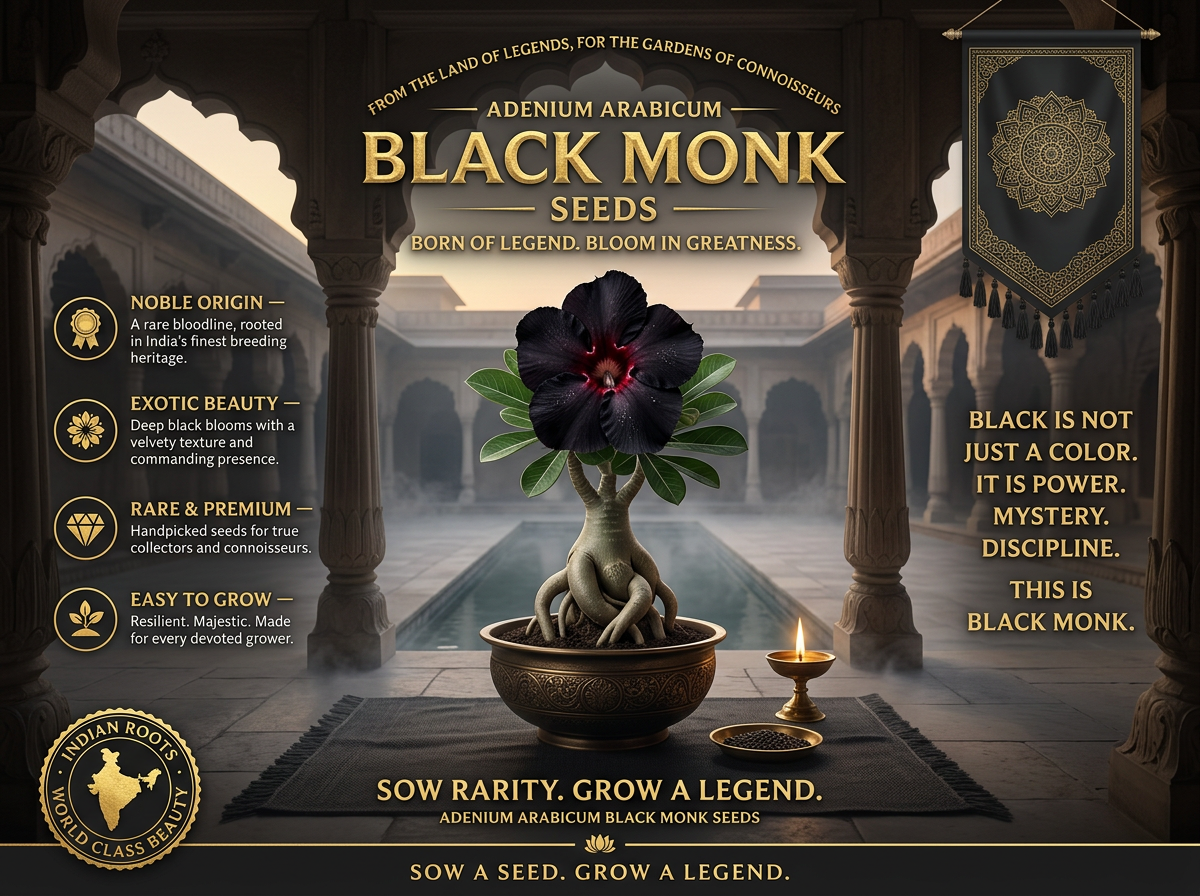
Adenium arabicum 'Black Monk' — Upright Dark Skin Thai Arabicum Seeds
Adenium arabicum 'Black Monk' — Upright Dark Skin Thai Arabicum Seeds
Couldn't load pickup availability
FREE U.S. SHIPPING ON ORDERS $75+ Mix and Match Seeds, Media and Supplies
Adenium arabicum 'Black Monk' — distributed through Thai and Indian breeding networks under its full designation Monsiam Monk Arabicum — is one of the most distinctive cultivar departures in the dark-skin arabicum lineage. Every other cultivar in the Black tier of Thai arabicum breeding is engineered for horizontal spread, low center of gravity, and flat pancake architecture. Black Monk is engineered for exactly the opposite. It grows up.
Understanding why that matters requires understanding what it produces — and what becomes possible with a dark-skin arabicum that is allowed, by its own genetics, to reach vertical height.
The Black Monk Distinction
The Thai and Indian breeding networks that developed and distribute this line gave it the Monk designation for a reason. Where the Black God, Black Hole, and Kalamae lines sit low and wide — commanding space through mass and horizontal presence — Black Monk commands space through height and vertical architecture. It is the structural outlier in the dark-skin arabicum world, and for a specific category of collector and bonsai grower, it is exactly what they have been looking for.
Key Visual Characteristics
Growth Habit — The Monk Silhouette
The defining feature of this cultivar is verticality. Instead of sprawling horizontally, Black Monk throws multiple tall, heavy, uniform branches straight upward from a muscular, well-developed caudex base. The branch structure is bold and architectural — not leggy or thin, but thick-set vertical columns reaching toward a high-clearance canopy. The silhouette reads as a miniature ancient forest tree or a pillar-style structural bonsai rather than the squat dwarf form that dominates the arabicum collector market. In containers, specimens typically top out around two feet — a height that creates genuine vertical presence without becoming unmanageable.
Bark & Skin
True dark-skin arabicum genetics — the same melanin-driven pigmentation mechanism found in Black God and Black Hole. The trunk expresses rich dark charcoal-gray, deep smoky purple, or matte copper-black coloration under intense UV conditions. The critical difference from the pancake lines is what the vertical habit does to bark presentation: the caudex and primary trunk are fully exposed and visible from every angle, not obscured under a low-hanging skirt of horizontal branches. The dark bark is the primary visual subject of the plant, displayed on an upright structure that reads more like sculpture than succulent.
Caudex
Because the branching grows vertically rather than laterally, the swollen, muscular base remains fully visible throughout the plant's development. There is no horizontal branch spread concealing the trunk line. The caudex develops a powerful, thick base with clearly defined trunk taper — the kind of base presentation that bonsai growers specifically train toward, delivered here by the natural growth habit of the cultivar.
Foliage
Classic thick, leathery arabicum leaf form. Under high UV stress, leaf veins and margins develop dark purple to reddish stress-pigmentation — consistent with the overall dark aesthetic of the Black lineage. The foliage sits in a high-clearance canopy above the exposed trunk, which is the correct structural relationship for vertical bonsai styling.
Flowers
Classic star-shaped light pink to bright fuchsia — standard arabicum flower expression. As with all cultivars in the dark-skin arabicum category, the visual payoff is the contrast: soft, vibrant pink blooms detonating against dark, vertical, heavily textured bark. The height of the Black Monk canopy means blooms are displayed above the dark trunk line rather than sitting on top of it — a fundamentally different compositional effect than the pancake cultivars produce.
Bonsai Potential — What Black Monk Makes Possible
Black Monk is the premier arabicum selection for collectors who want to wire and train a classic extended canopy bonsai rather than managing a flat crown. The vertical branch habit does not need to be fought or suppressed — it is the raw material for traditional bonsai upper canopy development. Let the primary branches gain vertical height, then wire secondary and tertiary branching outward to create a precisely spaced, umbrella-like crown above a dark, exposed, tapered trunk. This is the bonsai structure that takes standard arabicum collectors years of aggressive pruning and wiring to approximate — Black Monk's genetics point in that direction from the start. For growers with bonsai training experience, this cultivar is a genuine canvas.
Cultivation Notes
UV Light for Color Lock
The near-black bark is a UV-triggered melanin response — the same mechanism operating in every dark-skin arabicum cultivar. Without intense, unfiltered direct sunlight or high-output full-spectrum LED lighting, the dark saturation fades toward dull smoky green. No shade cloth, no standard window glass, no compromised light positions. Black Monk needs maximum UV exposure to maintain the bark color that defines it. In Zone 6, that means the best outdoor sun position from late May through early September — every high-UV outdoor day builds and locks in dark skin pigmentation.
Media
Despite being a more robust grower than the ultra-compact dwarf hybrids, Black Monk remains highly sensitive to stagnant moisture around the root system. It requires the same hyper-porous, inorganic-dominant substrate as all Thai arabicum cultivars — 80–90% pumice, lava rock, and coarse perlite. I use Desert Oasis Potting Media for all my dark-skin arabicum lines. The mineral-forward composition maintains the oxygen-to-moisture ratio the root system requires and eliminates residual moisture retention between waterings. Do not compromise on substrate porosity because the plant is a stronger grower — root rot sensitivity does not diminish with vigor.
Hard Winter Dormancy
Black Monk follows strict arabicum dormancy. When foliage yellows and drops in autumn, cease watering completely. A dark-skin arabicum held in cold, damp substrate during dormancy is at acute risk for fast-moving, fatal caudex rot. Dry storage, 55°F minimum, zero to minimal water until clear signs of active growth return in spring. The vertical branching structure of Black Monk coming out of dormancy — bare dark trunk and branch columns flushing with new growth and blooms — is one of the more distinctive seasonal displays in a Zone 6 adenium collection.
Zone 6 Notes
Outside after May 15 when nights are consistently above 50°F. Best direct sun position in your growing space — no compromises for any dark-skin arabicum line. I bring Black Monk in before first hard frost in mid-October and transition directly to dry dormancy storage. The vertical habit makes container management straightforward — it occupies a defined vertical footprint rather than spreading wide, which actually simplifies overwintering logistics compared to the wide pancake cultivars. Black Monk builds structural presence season over season. It is a long-term collection plant.
WHAT'S INCLUDED
- Fresh Adenium arabicum 'Black Monk' seeds (select quantity above)
- Germination instructions included with every order
GROWING BASICS
- Germination temp: 85–95°F
- Germination time: 5–14 days under ideal conditions
- Hardiness: Bring indoors before nighttime temps reach 50°F
- Light: Full unfiltered direct sun mandatory — UV locks in dark bark pigmentation
- Media: 80–90% inorganic mineral mix required
- Dormancy: Hard winter dormancy — cease watering when leaves drop
- Bonsai potential: Premier selection for upright canopy and pillar-style training
- Skill level: Intermediate — light management, dormancy protocol, and optional bonsai training
Also available in the Adenium arabicum Form Study Set — five seeds each of this cultivar and four others chosen for completely different caudex forms, sown side by side as a single comparison.
What You'll Need to Grow These
Seeds are only half the equation — germination success comes down to the right setup. Here's what I use:
∙ Desert Oasis Potting Media — the fast-draining inorganic mix built for Adenium, Plumeria, and caudex seedlings once they're up and potted on.
∙ Luxbird Seed Germinator & Propagation Kit — bottom heat and a humidity dome, the two things that push arabicum germination toward the 90%+ range.
∙ 5×5 Germination Tray — sized for clean single-variety sowing so nothing gets crossed up.
See the full Desert Oasis media range at americanadenium.com.