American Adenium
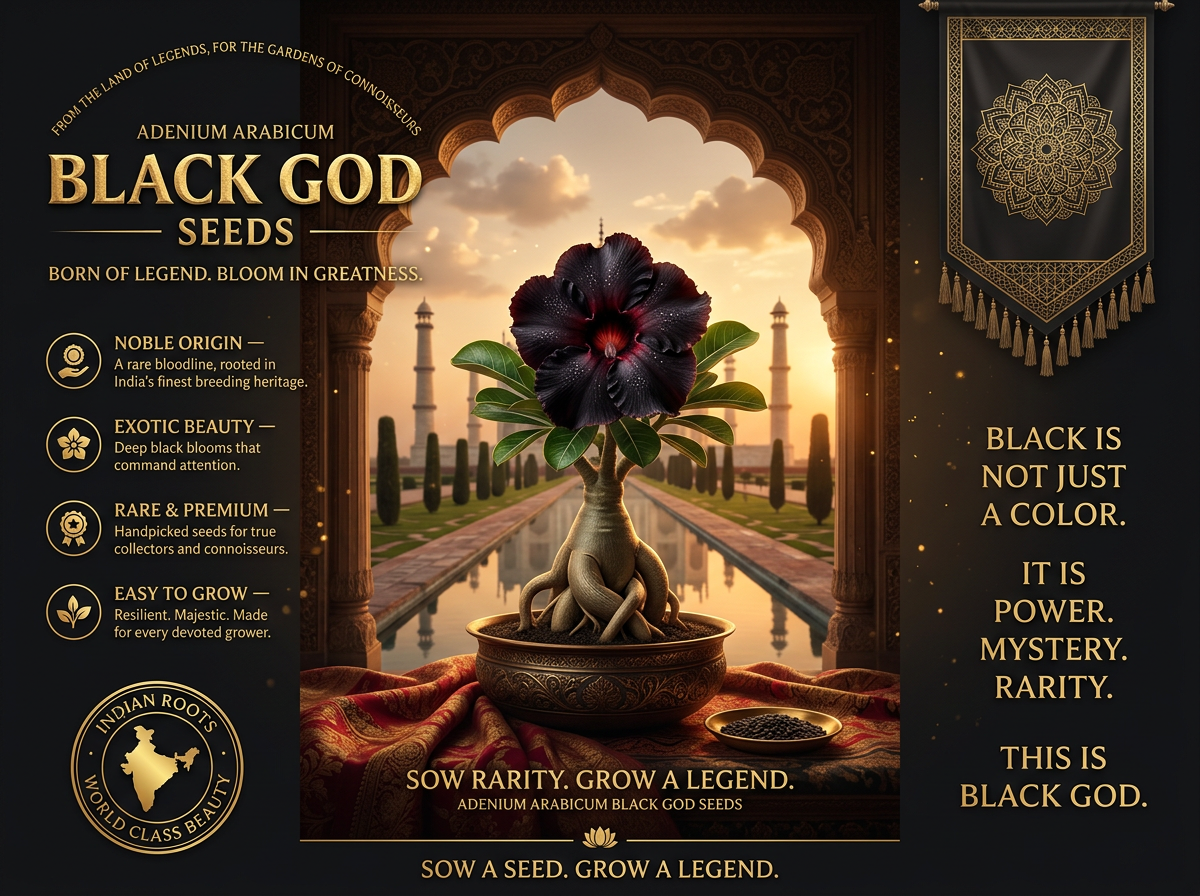
Adenium arabicum 'Black God' — Elite Dark Skin Thai Arabicum Seeds
Adenium arabicum 'Black God' — Elite Dark Skin Thai Arabicum Seeds
Couldn't load pickup availability
Adenium arabicum 'Black God' is a premier dark-skin Thai arabicum cultivar developed within the same elite breeding circles that produced Kalamae, Black Zebra, and Godji. Where many arabicum lines balance multiple traits — flower color, compactness, root spread — Black God has a single focused objective: the most intense dark epidermal pigmentation achievable on a premium arabicum structural base. Everything else follows from that.
The Black God Lineage
Black God belongs to the top tier of charcoal- and violet-skinned arabicum cultivars — lines engineered specifically for dramatic trunk aesthetics and architectural bonsai form. It is not a flower hybrid. It is not a cross chasing dark blooms on an arabicum base. It is a pure arabicum dark-skin selection, refined through generations of deliberate breeding to maximize melanin expression in the epidermis while maintaining elite structural characteristics throughout the plant.
Understanding this distinction matters when you are building a collector-grade arabicum program. Black God is a structural and aesthetic cultivar. Its flower color is standard arabicum pink — and that is precisely the point.
Key Visual Characteristics
Bark & Skin — The Defining Feature
The trunk displays deeply saturated charcoal-gray, dark copper, or dark purple-black coloration — a complete departure from the pale gray or silvery-green bark of wild-type arabicum. This dark pigmentation is UV-dependent and intensifies progressively under high-light conditions. On a mature specimen given optimal sun exposure, the trunk reads as near-black. The aging process amplifies the effect — prominent wrinkles, deep branch scarring, and surface texture that develops over years of high-light growing.
Caudex & Root Structure
Textbook premium arabicum geometry. Low-slung, squat, massively swollen dome or pancake caudex with highly aggressive lateral root development. The nebari — the radiating root flare at the base — is a defining characteristic of the Black God form. Trained with exposed surface roots from early in development, the root architecture anchors the dark trunk in a way that reads immediately as a finished bonsai composition. There is no period of awkward vertical development to grow through. The plant builds its form from the base up, early.
Branching & Canopy
Black God is bred for excellent self-branching. It throws an abundant ring of thick, short, heavy horizontal branches directly from the upper rim of the caudex — a dense, multi-tiered canopy without aggressive pruning intervention. The internodes are compressed. The branching is radial and symmetrical. The result is a crown-like canopy that complements the architectural base rather than competing with it.
Foliage
Broad, thick, and leathery — true arabicum leaf form. Under intense direct sunlight, leaves develop strong stress-pigmentation: dark purple to reddish margins and veins that echo the moody coloration of the bark. The entire plant moves toward a unified dark aesthetic under optimal light conditions — trunk, branch, and leaf margin all pulling in the same direction.
Flowers
Classic crisp star-shaped light pink to bright fuchsia — standard arabicum flower expression. This is not a weakness of the variety. It is the entire visual strategy. Soft, vibrant pink blossoms opening against near-black, deeply textured, muscular bark is one of the most striking contrasts available in the adenium world. The flowers do not need to be dark. The trunk is already doing that work.
Cultivation Notes — Keeping Black God at Its Best
UV Light is the Primary Input
The charcoal-black skin is a direct biological response to intense ultraviolet light. This is not a marketing claim — it is the mechanism behind dark-skin arabicum pigmentation across all cultivars in this tier. Under heavy shade cloth, filtered greenhouse glazing, or indoor conditions without high-output full-spectrum LED lighting, melanin production slows and the dark bark fades toward dull smoky green. Full, unfiltered direct sun is required to maintain the pitch-dark epidermis. In Zone 6, that means prioritizing Black God for your best outdoor sun position from late May through early September and supplementing aggressively if you are extending the season indoors.
Media
Black God is unforgiving with wet roots — more sensitive than standard wild-type obesum. It requires hyper-porous, inorganic-dominant substrate: 80–90% pumice, lava rock, and coarse perlite. I use Desert Oasis Potting Media for all my dark-skin Thai arabicum lines — the mineral-forward composition delivers the oxygen-to-moisture ratio the compact caudex root system requires. Never plant Black God in a mix that retains residual moisture between waterings.
Winter Dormancy
Hard arabicum dormancy applies. When foliage yellows and drops in autumn, cease watering almost entirely. A dark-skin dwarf arabicum held in damp substrate through cold dormancy is extremely vulnerable to caudex rot — the compact root zone has very little buffer against sustained moisture during its rest period. Dry storage at 55°F minimum, minimal to no water until spring temperatures trigger active growth. The flush of pink blooms on bare, dark-barked branches coming out of a properly managed dormancy is the payoff.
Zone 6 Notes
I move arabicum cultivars outside after May 15 when nights are reliably above 50°F and give them the highest-intensity sun position available. Every outdoor high-UV day is a deposit into the dark skin development of these plants — the color builds progressively through the season and is most intense by late August and September. I bring them in before first hard frost, move them directly into dry dormancy storage, and let them rest until March. Black God is a long-term investment plant — it improves every season it is managed correctly.
WHAT'S INCLUDED
- Fresh Adenium arabicum 'Black God' seeds (select quantity above)
- Germination instructions included with every order
GROWING BASICS
- Germination temp: 85–95°F
- Germination time: 5–14 days under ideal conditions
- Hardiness: Bring indoors before nighttime temps reach 50°F
- Light: Full unfiltered direct sun mandatory — dark skin is UV-dependent
- Media: 80–90% inorganic mineral mix required
- Dormancy: Hard winter dormancy — cease watering when leaves drop
- Skill level: Intermediate — light intensity and dormancy management are critical
Also available in the Adenium arabicum Crown Study Set — five seeds each of this cultivar and four others chosen for completely different canopy forms, sown side by side as a single comparison.
What You'll Need to Grow These
Seeds are only half the equation — germination success comes down to the right setup. Here's what I use:
∙ Desert Oasis Potting Media — the fast-draining inorganic mix built for Adenium, Plumeria, and caudex seedlings once they're up and potted on.
∙ Luxbird Seed Germinator & Propagation Kit — bottom heat and a humidity dome, the two things that push arabicum germination toward the 90%+ range.
∙ 5×5 Germination Tray — sized for clean single-variety sowing so nothing gets crossed up.
See the full Desert Oasis media range at americanadenium.com.