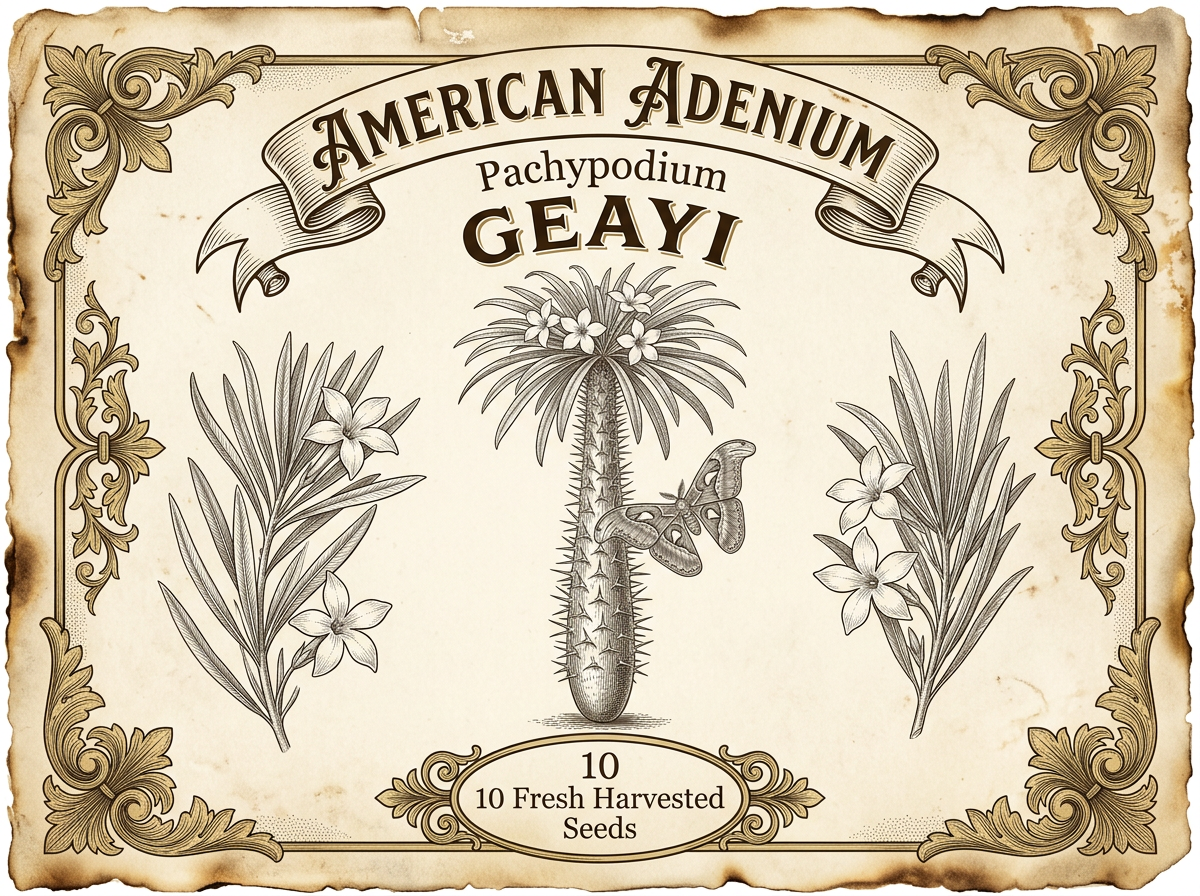
Pachypodium geayi — Silver Pachypodium Caudiciform Seeds - 10 Seed Pack
Pachypodium geayi — Silver Pachypodium Caudiciform Seeds - 10 Seed Pack
Couldn't load pickup availability
FREE U.S. SHIPPING ON ORDERS $75+ Mix and Match Seeds, Media and Supplies
Pachypodium geayi is the sleeker, more refined sibling of lamerei — sharing the same heavily spined, columnar Madagascar architecture but distinguished by dramatically narrower leaves covered in fine silver hairs that give the entire crown a pale, ghostly shimmer. Where lamerei builds a broad, branching candelabra over time, geayi tends to stay a single, clean, upright column — taller, more slender, and arguably more striking as a standalone specimen.
FULL PRODUCT DESCRIPTION
Pachypodium geayi (Silver Pachypodium / Gray Pachypodium) is a close botanical relative of lamerei, native to the same arid southwestern plateau regions of Madagascar, and a member of the same Apocynaceae family that includes Adenium. The two species share fundamental care requirements — fast drainage, maximum heat and light, cold intolerance, and aggressive summer watering — but geayi delivers a distinctly different visual experience.
The Trunk
Like lamerei, geayi builds a heavily spined, columnar silver-gray trunk with spine clusters emerging in symmetrical three-point arrangements directly from the bark. The trunk tends toward a more slender, refined diameter than lamerei, maintaining a clean, single-column silhouette rather than branching aggressively into a candelabra. The spines are slightly longer and more prominent relative to trunk diameter, giving geayi a sharper, more aggressively armed appearance.
The Crown — The Key Differentiator
This is where geayi separates itself clearly from lamerei. The leaves are significantly narrower — long, linear, and strap-like rather than lamerei's broader, glossier profile. The defining feature is a dense covering of fine silver hairs on both leaf surfaces, giving the entire crown a pale, silvery-gray shimmer rather than the deep glossy green of lamerei. In strong direct sunlight, the silver leaf sheen creates a striking visual effect against the spined trunk below.
The Flowers
Mature geayi produces large, pure white star-shaped blooms identical in general form to lamerei — five petals, clean and high-contrast — emerging from the growing tip before or alongside new leaf growth.
Growth Rate and Form
Geayi is generally considered a slightly slower grower than lamerei and tends to retain its single-column form longer before branching. This makes it the better choice for growers specifically chasing a tall, clean, single-trunk specimen rather than the multi-branched candelabra that mature lamerei develops.
Zone 6 Notes
My Zone 6 experience with geayi mirrors lamerei in every practical sense — strictly a container plant, indoors well before nighttime temperatures approach 50°F in early to mid-October, south-facing windowsill or under grow lights through winter, aggressive watering during summer heat, sharp reduction in autumn as temperatures drop. The one meaningful difference I have noted: geayi runs slightly more sensitive to cold drafts and temperature fluctuation than lamerei, so I bring it in a week or two earlier and keep it away from cold windows through the winter months. Same substrate philosophy as my entire Adenium and Pachypodium line — fast-draining, inorganic-heavy mix, Desert Oasis Potting Media or comparable. No true hard dormancy required in Zone 6 — keep it warm, reduce water, maintain strong light through winter.
WHAT'S INCLUDED
- Fresh Pachypodium geayi seeds - 10 Seed Pack
- Germination instructions included with every order
GROWING BASICS
- Germination temp: 80–90°F
- Germination time: 7–21 days under ideal conditions
- Hardiness: Bring indoors before nighttime temps approach 50°F — slightly more cold-draft sensitive than lamerei
- Light: Maximum direct sun or high-output full-spectrum LED — silver leaf shimmer and columnar form both degrade in low light
- Media: Fast-draining, inorganic-heavy mix (Desert Oasis Potting Media or comparable)
- Watering: Aggressive in summer heat; reduce sharply in autumn and winter
- Dormancy: No true hard dormancy required — keep warm, reduce water, maintain strong light through winter
- Growth rate: Moderate for a caudiciform — slower than lamerei, rewards patient long-term growing
- Skill level: Beginner to intermediate — slightly more temperature-sensitive than lamerei but same fundamental care requirements
What You'll Need to Grow These
Seeds are only half the equation — germination success comes down to the right setup. Here's what I use:
∙ Desert Oasis Potting Media — the fast-draining inorganic mix built for Adenium, Plumeria, Pachypodium, and other caudex seedlings once they're up and potted on.
∙ Luxbird Seed Germinator & Propagation Kit — bottom heat and a humidity dome, the two things that push caudiciform germination toward the 90%+ range.
∙ 5×5 Germination Tray — sized for clean single-variety sowing so nothing gets crossed up.
See the full Desert Oasis media range at americanadenium.com.