American Adenium
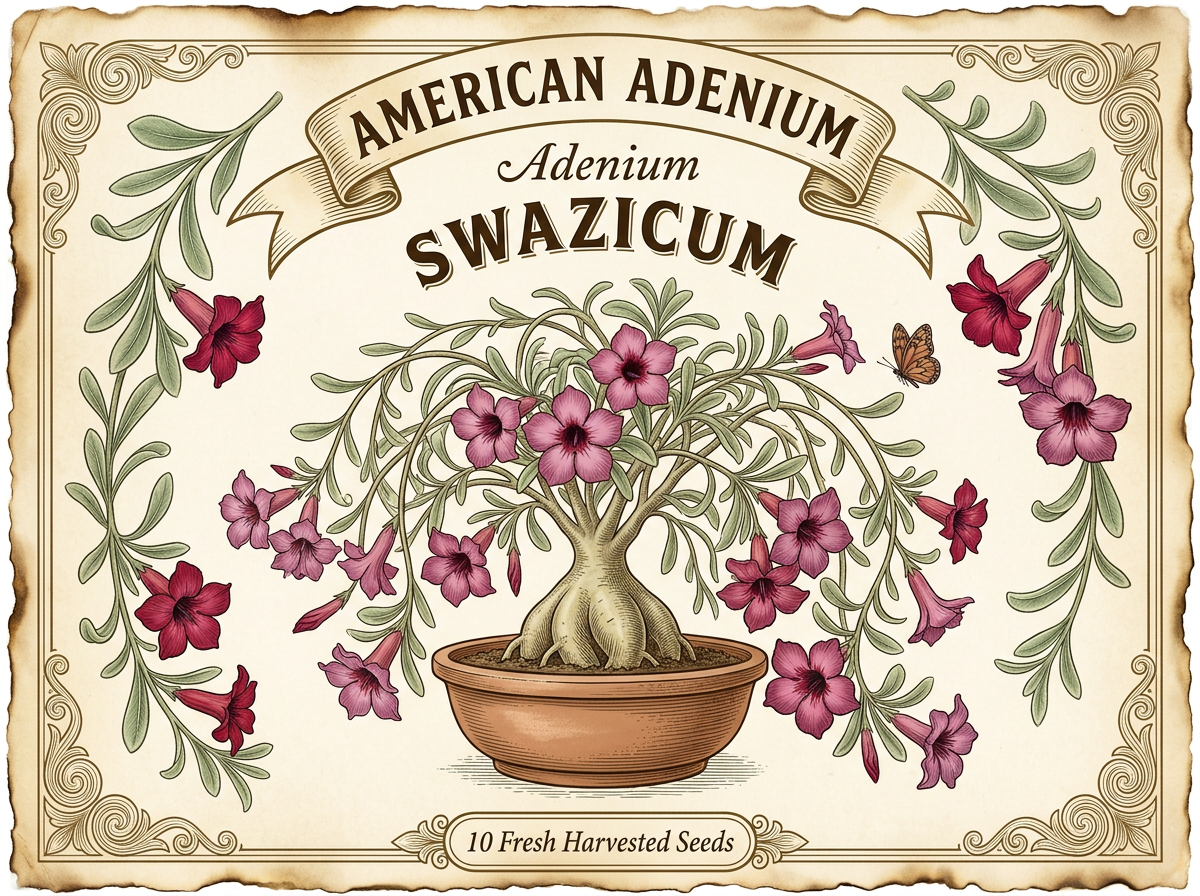
Adenium swazicum — Summer Impala Lily Seeds (Southern Africa Species)
Adenium swazicum — Summer Impala Lily Seeds (Southern Africa Species)
Couldn't load pickup availability
FREE U.S. SHIPPING ON ORDERS $75+
Adenium swazicum — Summer Impala Lily Seeds (Southern Africa Species)
*SOLD AS PER EACH SEED NOT AS A PACK OF SEEDS*
Adenium swazicum is the species that changed adenium hybridizing. Native to Eswatini, South Africa, and Mozambique, it introduced cold tolerance, extended bloom season, and solid deep-pink flower color to the modern cultivar gene pool. As a species plant in its own right, it offers a growth habit and leaf form unlike anything in the arabicum or Thai hybrid lines — and it performs better in marginal conditions than any other adenium species you can grow.
FULL PRODUCT DESCRIPTION
Adenium swazicum — the Summer Impala Lily — is a distinct Southern African species that occupies a unique position in the adenium world. It is not a Thai hybrid. It is not bred for extreme caudex architecture or bonsai form. It is a true species plant with specific adaptations built over millennia in the subtropical grasslands of Eswatini, South Africa, and Mozambique — and those adaptations make it one of the most practically useful adeniums a collector can own.
Species Origin & Background
In its native habitat, A. swazicum grows as a small dwarf shrub rarely exceeding one to two feet in height. The caudex is typically buried underground — a direct adaptation to survive grassland fires and grazing pressure. In cultivation, that same buried-caudex habit produces a smooth, pale grayish-green to whitish trunk with flexible, slender branches that sprawl outward rather than reaching vertically. It is a fundamentally different growth expression than the massive, dark-barked arabicum lines or the architecturally engineered Thai hybrids.
Key Visual Characteristics
Foliage
The leaves are the most immediately recognizable feature. Long, narrow, and strap-like — oblanceolate to nearly linear — they measure four to five inches in length but less than an inch wide. The color is a distinct pale, dusty green with fine velvety pubescence covering the surface. Leaf margins tend to wave or fold upward slightly. This is nothing like the broad, flat foliage of A. arabicum or the dense curled canopy of DHA-type hybrids. If you are used to standard adenium foliage, swazicum reads as an entirely different plant.
Flowers
A. swazicum produces flat, wide-open flowers in solid pink, deep fuchsia, or rich purple-pink — uniform color throughout the petal surface, deepening into the throat rather than fading to a pale center. The absence of the prominent nectar guide stripes typical of A. obesum gives swazicum flowers a bold, saturated, jewel-tone quality. Color is consistent and reliable from seed-grown plants — this species does not produce the wide floral variation of hybrid crosses.
Caudex
Smooth, pale, and relatively compact — not the dramatic wrinkled dark bark of arabicum bonsai lines. Swazicum grown with the caudex elevated above the substrate develops a clean, elegant base. Its value is not in dramatic caudex architecture — it is in the total plant presentation: a relaxed, natural form with exceptional flower coverage.
Where Swazicum Fits in the Adenium World
A. swazicum's most significant contribution to modern adenium culture is genetic. Early breeders crossed it heavily with A. obesum specifically to capture three traits that A. obesum lacked: solid deep-pink flower color, extended late-season bloom, and improved cold tolerance. The result was a generation of floriferous, cold-hardy cultivars — including 'Crimson Star' and 'Anacapa' — that owe their toughness and color directly to swazicum parentage. If you grow any of the popular cold-hardy cultivars, you are already growing swazicum genetics.
As a species plant, it stands on its own merits.
Cultivation Notes — What's Different from Standard Adeniums
Extended Bloom Season
In warm conditions, A. swazicum does not follow the same dormancy timeline as A. arabicum or A. multiflorum. It can retain foliage and continue pushing flowers well into autumn — sometimes into early winter under shelter. For Zone 6 growers, this means swazicum will often still be blooming when you bring it indoors for the season, and it may continue flowering on a windowsill or under grow lights into November.
Cold Tolerance
This is the most practically important trait swazicum offers to cold-climate growers. It is widely regarded as the most cold-tolerant species in the genus — not freeze-hardy, but significantly more tolerant of cool, damp shoulder-season conditions than East African Adenium species. It handles the cool nights of early May and mid-September in Northern Kentucky without the stress response you see in arabicum lines under similar conditions. This matters when you are managing container plants through a short outdoor season.
Pest Resistance
The velvety pubescence on the foliage provides measurable resistance to spider mite pressure — one of the primary pests on standard adenium collections. Swazicum consistently outperforms smooth-leafed species and hybrids in this regard. In a mixed collection, it is typically the last plant to show mite damage and the first to recover.
Media & Watering
Despite its greater tolerance for moisture and cool conditions relative to arabicum, A. swazicum still requires fast-draining substrate. Do not interpret its adaptability as permission to grow it in standard potting mix. I use Desert Oasis Potting Media for all my swazicum plants — the mineral-forward composition keeps the root zone aerated without creating the bone-dry extremes that arabicum demands. Swazicum will tolerate slightly more consistent moisture during active growth than arabicum, but stagnant wet roots will still kill it.
Zone 6 Notes
Swazicum is my first adenium outside in spring and my last one in before fall. In Northern Kentucky I move it out in late April if nights are consistently above 45°F — earlier than I would risk an arabicum. It goes to a sheltered spot initially, then full sun once we are solidly past frost. I bring it in at first hard frost warning rather than waiting for a set temperature threshold, because it is often still in active growth and bloom at that point. Overwinter at 55°F minimum with reduced water — it may hold some foliage through winter, which is normal.
WHAT'S INCLUDED
- Fresh Adenium swazicum species seeds (select quantity above)
- Germination instructions included with every order
GROWING BASICS
- Germination temp: 80–90°F
- Germination time: 5–14 days under ideal conditions
- Cold tolerance: Most cold-tolerant Adenium species — handles cool shoulder-season conditions better than arabicum
- Bloom season: Heavy summer bloomer; may continue into fall under warm conditions
- Light: Full direct sun preferred
- Skill level: Beginner-friendly — more forgiving than arabicum or Thai hybrids
What You'll Need to Grow These
Seeds are only half the equation — germination success comes down to the right setup. Here's what I use:
∙ Desert Oasis Potting Media — the fast-draining inorganic mix built for Adenium, Plumeria, and caudex seedlings once they're up and potted on.
∙ Luxbird Seed Germinator & Propagation Kit — bottom heat and a humidity dome, the two things that push germination toward the 90%+ range.
∙ 5×5 Germination Tray — sized for clean single-variety sowing so nothing gets crossed up.
See the full Desert Oasis media range at americanadenium.com.