American Adenium
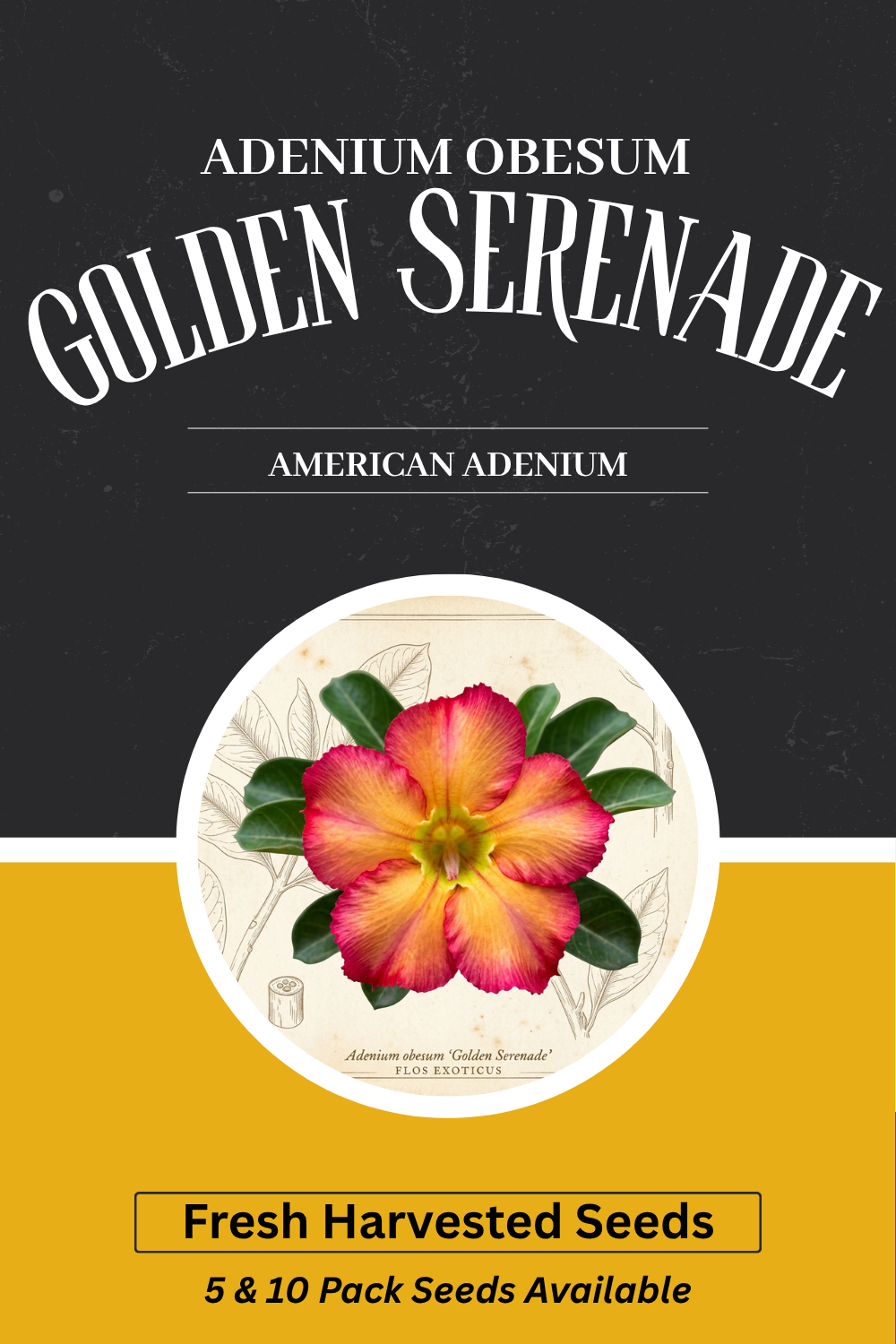
Adenium obesum 'Golden Serenade' — Double-Petal Pastel Desert Rose Seeds
Adenium obesum 'Golden Serenade' — Double-Petal Pastel Desert Rose Seeds
Couldn't load pickup availability
Adenium obesum 'Golden Serenade' is a soft-palette double-petal selection out of the Thai hybrid programs — a departure from the saturated reds and near-blacks that dominate most obesum breeding. If your collection is heavy on dark and dramatic, this is the one that balances the shelf.
Flower Form
Multi-layered double petals with lightly ruffled margins. Under good light and steady feeding, mature plants push a full, layered bloom rather than the flat five-petal single form. Petal count on doubles is genetically variable — expect a range across a seed batch, with the strongest layering showing up once plants are past their second year.
Color
Creamy lemon-yellow through the center, transitioning out to blush-pink margins, with a warm golden-lime throat. The yellow reads strongest in cooler growing windows; higher heat tends to push the pink edging wider. That seasonal shift is normal and worth noting if you're tracking bloom photos across a season.
Caudex & Growth Habit
Standard obesum architecture — a thick, swelling caudex that builds steadily with a smooth taper into the trunk. Less squat and horizontal than arabicum, more vertical and sculptural. Good subject for specimen potting or bonsai-style training, and it responds well to early root work if you're lifting and spreading roots at the first transplant.
From Seed
These come from hand-pollinated mother plants sourced through my top Thai breeder network. Understand what that means: hybrid obesum seed carries real genetic variation. Seedlings hold strong parental traits — the pastel yellow-to-pink range and the double form — but individual bloom color and petal layering will vary plant to plant. That is not a defect. It is how new line variations get found, and it is the main reason I still grow from seed instead of buying grafted plants.
Zone 6 Notes
I run obesum outdoors in Northern Kentucky from late May through early September, then bring everything in before overnight lows approach 50°F. Obesum is less cold-forgiving than arabicum, so I don't push the shoulder seasons with it. Under lights indoors from October through April, a seedling sown now is a candidate for first bloom in its second season. Cold-climate growers get an advantage here that warm-climate growers never build: the forced indoor season makes you precise about media, water, and light, and it shows in the caudex.
WHAT'S INCLUDED
- Fresh hand-harvested Adenium obesum 'Golden Serenade' seed (select quantity above)
- Germination and seedling care instructions with every order
GROWING BASICS
- Germination temp: 85–90°F, bottom heat
- Germination time: 5–14 days under ideal conditions
- Light: Bright indirect until first true leaves, then full sun; minimum 6 hours direct
- Water: Evenly moist through germination, never saturated. Begin drying cycles once the caudex starts to swell.
- Media: Fast-draining, high-porosity mineral mix from day one
- Hardiness: Bring indoors before temps drop below 50°F
What We're Growing With
Seeds are only half the equation — germination success comes down to the setup. Here's what I use:
∙ Desert Oasis Potting Media — the fast-draining inorganic mix built for Adenium, Plumeria, and caudex seedlings once they're up and potted on.
∙ Luxbird Seed Germinator & Propagation Kit — bottom heat and a humidity dome, the two things that push obesum germination toward the 90%+ range.
∙ 5×5 Germination Tray — sized for clean single-variety sowing so nothing gets crossed up.
See the full Desert Oasis media range at americanadenium.com.
Michael White — ISA Certified Arborist (KY-0847A), Kentucky Master Gardener. Growing Adenium in Zone 6 since 1994.