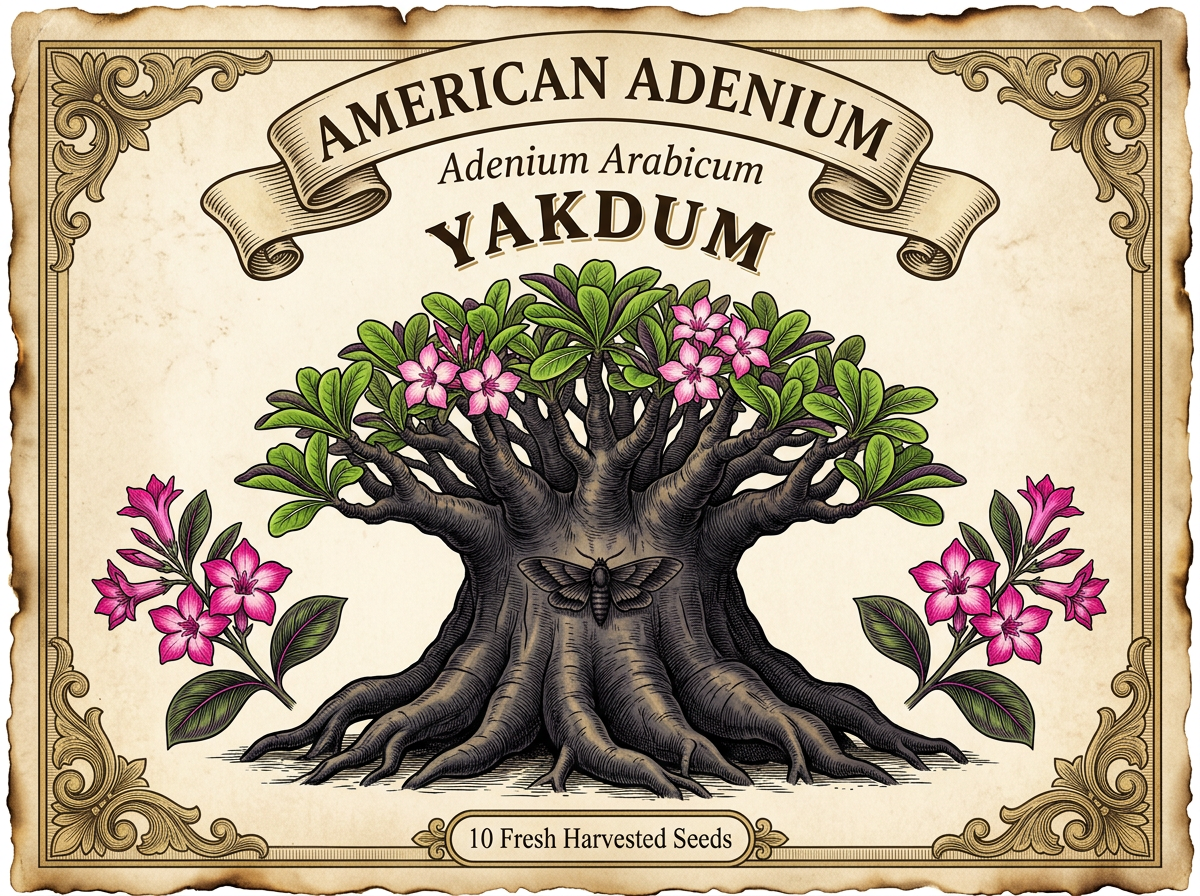
Adenium arabicum 'Yakdum' — Black Giant Thai Hybrid Seeds
Adenium arabicum 'Yakdum' — Black Giant Thai Hybrid Seeds
Couldn't load pickup availability
FREE U.S. SHIPPING ON ORDERS $75+ Mix and Match Seeds, Media and Supplies
Yakdum means "Black Giant" in Thai — and it delivers on both words. Coming out of the Arabicum House / Mr. Ram breeding networks, this elite line combines aggressively massive, giant-scale arabicum skeleton with high-expression dark charcoal skin genetics. This is not a dwarf line. It builds enormous, heavily flared trunk mass and dense self-branching canopy, all wrapped in a smoky, dark charcoal-bronze-purple bark.
FULL PRODUCT DESCRIPTION
Adenium arabicum 'Yakdum' (also seen as Yak Dum or Chada Dum variants) comes out of some of the most respected breeding networks in Thailand — Arabicum House and Mr. Ram's program — with a single objective: combine a massive, giant-scale arabicum skeleton with intensely dark skin expression.
The Bark — The "Dum" Aesthetic
Yakdum's signature is a deeply saturated dark charcoal-gray to matte bronze-purple epidermis. Under intense UV, the skin develops a smoky, weathered patina that contrasts sharply against the bright green canopy. This is a pigmentation-first line, and the bark is the entire visual argument.
Giant Yet Proportional Anatomy
Unlike DHA dwarf lines, Yakdum carries real "Yak" (Giant) genetic potential — a massive, muscular, incredibly heavy trunk base. It doesn't shoot vertical into a leggy tree; instead it builds wide, growing into a heavily flared dome with serious structural presence at every stage of development.
Branching and Internodes
High-density self-branching is a hallmark of this line. A dense, structural ring of thick, stubby primary branches with tightly stacked internodes creates a layered crown that naturally mimics the look of an ancient, heavy-wooded canopy.
Foliage and Roots
Broad, thick, slightly obovate leathery leaves with dark purple pigmentation picking up in the leaf margins and veins under high light stress. At the base, thick, heavy lateral roots (nebari) flare wide, locking the massive dark trunk into the substrate.
Flowers
Classic, high-contrast light pink to bright fuchsia star-shaped blooms — the bright flowers against the dark bark are a striking combination at peak flush.
Zone 6 Notes
I treat Yakdum exactly like my other dark-skin lines on light: maximum unfiltered direct sun, no exceptions. Drop below full sun intensity and the melanin production slows, the bark reverts toward smoky dull green, and the whole point of growing this line disappears. Outside in the hottest, brightest spot after May 15. Because it has the capacity to put on serious tissue weight fast during peak summer, I run it in an 80–90% inorganic mix — premium pumice, black lava rock, coarse perlite — so the massive root system never sits in stagnant water. Winter dormancy is non-negotiable and strictly dry: when foliage drops, water stops completely. A dark-skinned, massive arabicum caudex held in cold damp media is the fastest path to irreversible rot I know of. Dry, cool, zero water until active spring growth resumes.
WHAT'S INCLUDED
- Fresh Adenium arabicum 'Yakdum' seeds (select quantity above)
- Germination instructions included with every order
GROWING BASICS
- Germination temp: 85–95°F
- Germination time: 5–14 days under ideal conditions
- Hardiness: Bring indoors before nighttime temps reach 50°F
- Light: Maximum unfiltered direct sun or high-output full-spectrum LED — bark reverts to dull green without it
- Media: 80–90% inorganic (premium pumice, black lava rock, coarse perlite)
- Dormancy: Strict dry winter dormancy — cease watering completely when foliage drops; damp cold media causes rapid caudex rot
- Skill level: Intermediate — high vigor but dark-skin pigmentation and dormancy protocol require discipline
What You'll Need to Grow These
Seeds are only half the equation — germination success comes down to the right setup. Here's what I use:
∙ Desert Oasis Potting Media — the fast-draining inorganic mix built for Adenium, Plumeria, and caudex seedlings once they're up and potted on.
∙ Luxbird Seed Germinator & Propagation Kit — bottom heat and a humidity dome, the two things that push arabicum germination toward the 90%+ range.
∙ 5×5 Germination Tray — sized for clean single-variety sowing so nothing gets crossed up.
See the full Desert Oasis media range at americanadenium.com.