American Adenium
Adenium arabicum 'Turtle' — Tortoise Shell Caudex Thai Hybrid Seeds
Adenium arabicum 'Turtle' — Tortoise Shell Caudex Thai Hybrid Seeds
Couldn't load pickup availability
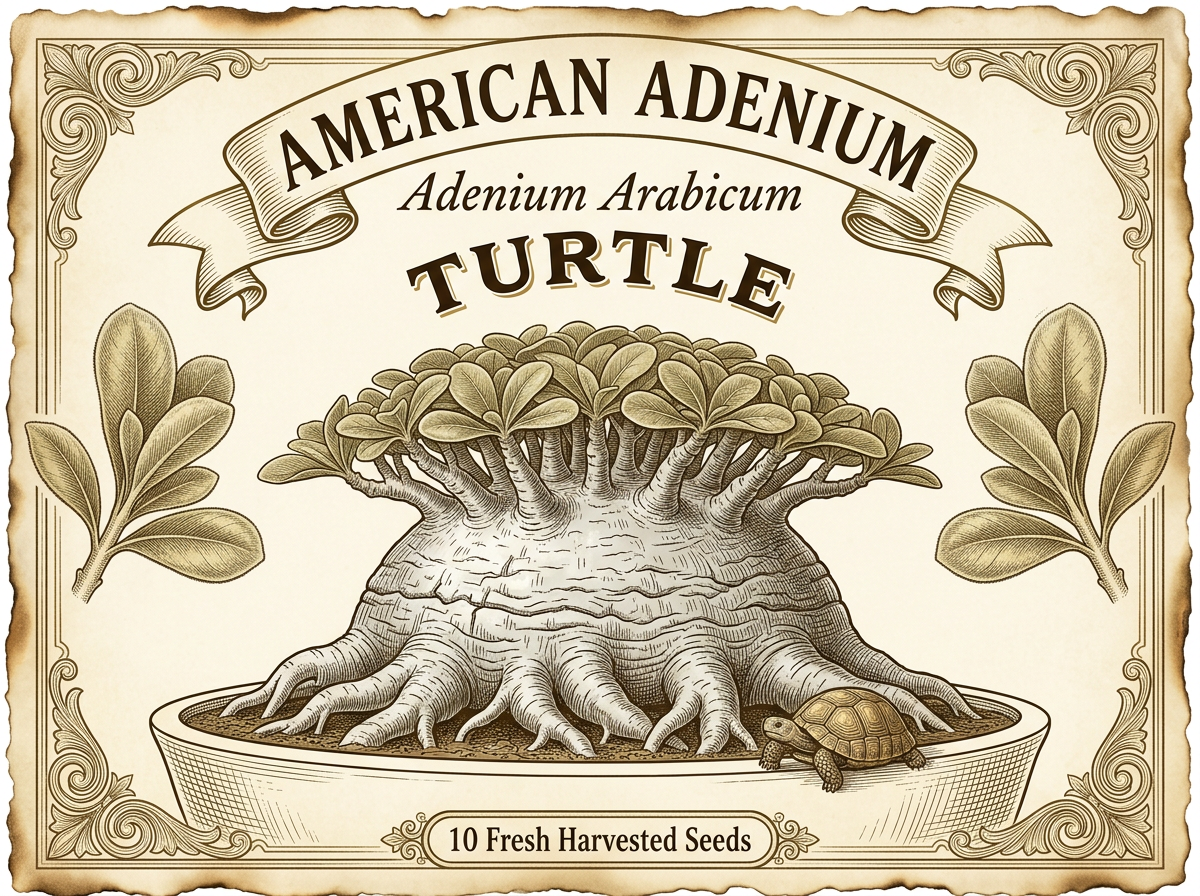
Turtle (also referenced as Mubarn or Khao Hin Zan Turtle) earns its name from one of the most distinctive caudex textures in the arabicum world — a heavy, wide, dome-shaped base with deep horizontal wrinkles and fissures that mirror the shell and aged skin of an ancient tortoise. This is a structural line, grown for texture and bone structure rather than flashy color or twisted leaves.
FULL PRODUCT DESCRIPTION
Adenium arabicum 'Turtle' is a classic Thai arabicum cultivar line built entirely around the texture and silhouette of its caudex. It is a masterclass in low-profile bone structure.
The "Turtle Shell" Caudex
The defining trait is the shape and texture of the base. Genetically driven to grow extremely wide, low, and flat-bottomed, it forms a heavy dome-like silhouette that deepens with age — pale silver-gray bark developing rugged horizontal wrinkles and fissures that genuinely resemble old reptile skin. No two specimens age identically, which makes mature Turtle plants genuinely unique specimens.
The Crown and Branching
A radial ring of short, incredibly thick, stubby primary branches drops straight from the upper rim of the dome. Tightly packed internodes produce a flat, umbrella-like canopy that hugs the top of the caudex closely rather than reaching upward or outward.
The Root Spread
Powerful, massive lateral roots (nebari) flare symmetrically from the bottom edge of the shell, giving the plant an immensely stable, anchored appearance. This is one of the best lines in the collection for shallow bonsai pot presentation — the exposed root flare completes the ancient-specimen look.
Foliage
Classic arabicum — broad, thick, slightly spoon-shaped leaves covered in a fine, soft velvety fuzz (pubescence) on both sides. Tactile and distinct at close range.
This line is entirely about patience and structure. A well-grown Turtle specimen that has aged through multiple seasons, developed its wrinkled shell texture, and had its nebari lifted and spread is one of the most visually compelling pieces in any arabicum collection.
Zone 6 Notes
The squat, heavy-set morphology of this line is entirely light-dependent — drop below maximum intensity and those stocky branches start to reach and stretch, permanently changing the compact turtle-shell silhouette you spent seasons building. I keep Turtle in my most intense direct-sun position outside after May 15, no shade cloth, no filtering. The broad, flat caudex design means more surface area sitting close to the soil line, so I run a heavily inorganic mix (80–90% premium pumice, black lava rock, coarse perlite or hard akadama) to prevent moisture trapping underneath the dome where base rot initiates fastest. Hard winter rest with zero water when foliage drops — this is a slow-grown specimen and cold wet media is the fastest way to lose years of development. Indoors before first hard frost in mid-October, dry and cool until active spring growth resumes.
WHAT'S INCLUDED
- Fresh Adenium arabicum 'Turtle' seeds (select quantity above)
- Germination instructions included with every order
GROWING BASICS
- Germination temp: 85–95°F
- Germination time: 5–14 days under ideal conditions
- Hardiness: Bring indoors before nighttime temps reach 50°F
- Light: Maximum intensity direct sun or high-output full-spectrum LED — critical for holding compact branch structure
- Media: 80–90% inorganic (premium pumice, black lava rock, coarse perlite or hard akadama) — flat dome base is rot-vulnerable if moisture is retained underneath
- Dormancy: Hard winter rest — zero water when foliage drops; cold wet media destroys slow-grown specimens
- Skill level: Intermediate — high patience requirement; structural texture rewards long-term growers
What You'll Need to Grow These
Seeds are only half the equation — germination success comes down to the right setup. Here's what I use:
∙ Desert Oasis Potting Media — the fast-draining inorganic mix built for Adenium, Plumeria, and caudex seedlings once they're up and potted on.
∙ Luxbird Seed Germinator & Propagation Kit — bottom heat and a humidity dome, the two things that push arabicum germination toward the 90%+ range.
∙ 5×5 Germination Tray — sized for clean single-variety sowing so nothing gets crossed up.
See the full Desert Oasis media range at americanadenium.com.