American Adenium
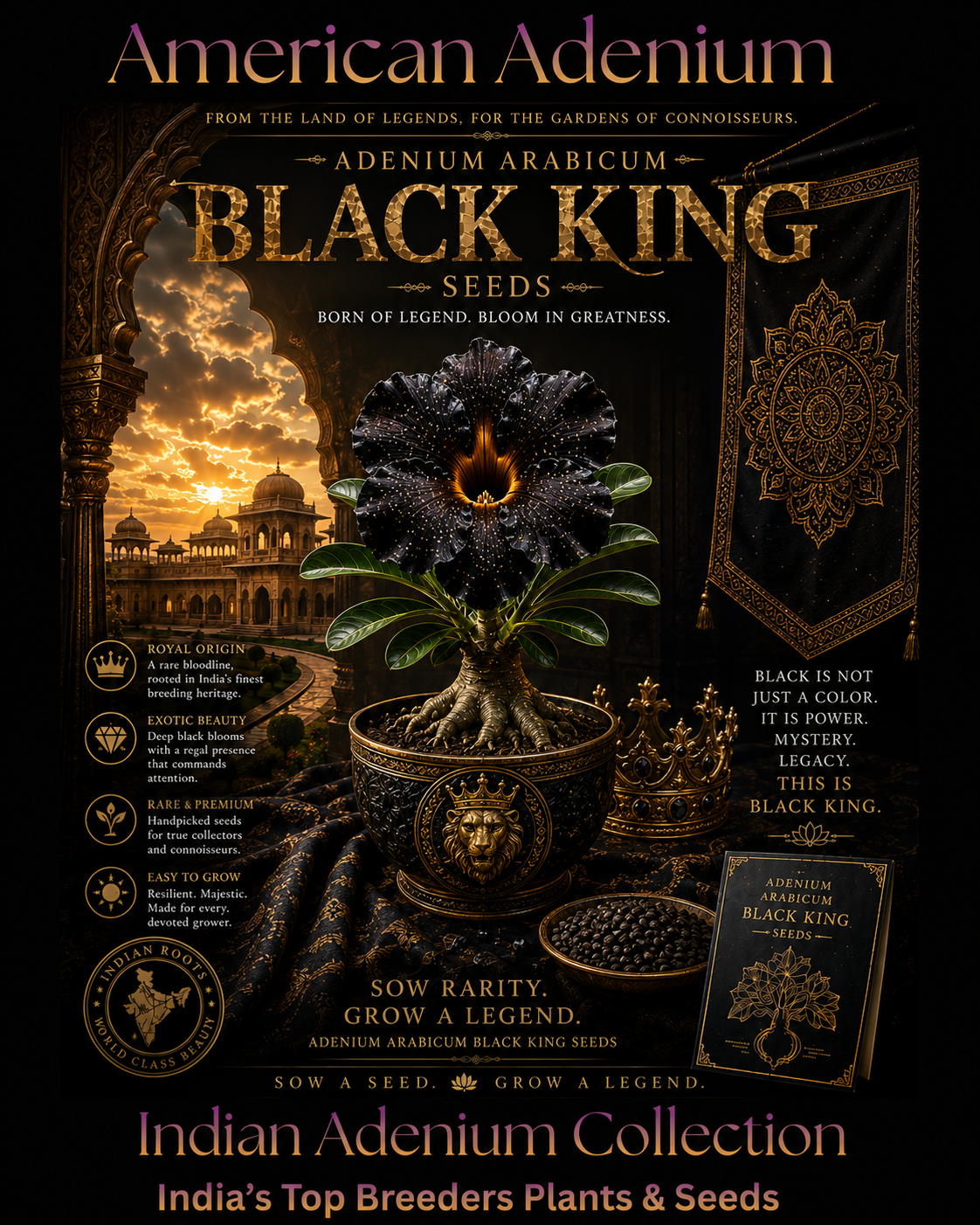
Adenium arabicum 'Black King' — Dark Skin & Dark Flower Thai Hybrid Seeds
Adenium arabicum 'Black King' — Dark Skin & Dark Flower Thai Hybrid Seeds
Couldn't load pickup availability
Adenium arabicum 'Black King' occupies a unique position in the Thai collector market — a name that references both a celebrated dark-skin arabicum structural line and one of the most recognized dark-flower obesum cultivars ever developed. Understanding the distinction matters before you buy, and it matters even more when you are evaluating seedlings as they develop.
Two Lineages, One Name
The Pure Arabicum Black King — Dark Skin Form
When experienced Thai arabicum collectors reference Black King in the same breath as Black Panther, Black Hawk, or Kalamae, they are talking about a pure arabicum dark-skin line — not a flower hybrid. The defining characteristic is the trunk epidermis: instead of the typical silver, pale gray, or bright green skin of standard arabicum, Black King develops a deeply saturated dark copper, dull purple, or charcoal-black trunk under high-light conditions. The growth habit is classic elite arabicum — very low, squat, dome-shaped or pancake caudex with massive lateral root spread, pushing a high density of short, thick, muscular branches directly from the base. The flowers on this form are standard star-shaped pink to light reddish-pink. The visual payoff is the contrast: delicate pale pink blooms opening against a pitch-dark, weathered, ancient-looking trunk. This is a structural collector plant.
The Hybrid Black King — Dark Flower Form
'Black King' is also an established name for a heavily saturated near-black Adenium obesum flower cultivar. Thai breeders have crossed this line extensively into arabicum genetics to produce A. arabicum × 'Black King' F2 and F3 selections — plants that combine the arabicum bonsai base architecture with the extreme dark flower expression of the obesum parent. On confirmed hybrid specimens, blooms are large, ruffled, and velvety — deep maroon to crimson-black, with petal edges so dark they read as charred or smoky charcoal, especially when the flower first opens. Achieving this on an arabicum bonsai base is the target.
What to Expect from Seed
These seeds carry genetics from the Black King lineage. As with all seed-grown adenium hybrids, individual seedlings will express a spectrum of traits across both parent lines.
Structural traits — the squat arabicum caudex, lateral root spread, compressed branching, and low center of gravity — carry reliably across the cross. The arabicum growth architecture is the dominant structural influence and will be visible early in seedling development.
Dark skin expression requires intensity of light to activate. Under full, unfiltered direct sun, the trunk develops the characteristic dark copper to charcoal-black pigmentation. Under filtered or low-UV conditions, it fades toward dull green. This is the same light-dependent pigmentation mechanism seen across all dark-skin Thai arabicum lines.
Dark flower expression follows hybrid genetics — meaning seedlings will produce a range of outcomes. A percentage will carry the deep maroon-to-near-black flower trait. Others will express lighter red or deep pink blooms with arabicum structure. This is not a defect — it is the nature of seed-grown dark-flower hybrids across the entire collector market. Growing out a cohort and selecting the darkest-flowering individuals is the standard approach. Guaranteed pitch-dark blooms on confirmed arabicum rootstock requires grafting.
Key Visual Characteristics
Bark & Skin
Dark copper, dull purple, or charcoal-black under optimal high-UV conditions. The epidermis ages dramatically — prominent wrinkles, visible branch scarring, and deep color saturation on mature trunks. This is a plant that looks better every year it grows.
Caudex & Branching
Classic elite arabicum architecture — pancake or dome-shaped base, extremely low center of gravity, massive lateral root spread. Branching is dense, short, thick-set, and horizontal. No leggy phase, no single dominant vertical stem. The bonsai structure is built into the genetics.
Foliage
Broad, thick, and leathery, with a subtle velvety sheen on the undersides. Under intense sunlight, leaf edges and veins can develop a dark purple to reddish stress-pigmentation that mirrors the trunk coloration — a cohesive dark aesthetic across the entire plant.
Flowers
Depending on lineage expression: classic pale pink on the pure dark-skin form; deep maroon to near-black ruffled blooms on confirmed hybrid expressions. Both are worth growing. The contrast of pink flowers on a black trunk is as striking as the dark flowers themselves.
Cultivation Notes
UV Light is Non-Negotiable
Both the dark skin pigmentation and the dark flower border expression are directly UV-dependent. Filtered greenhouse light, shade cloth, or indoor growing without high-output supplemental lighting will fade the dark skin to dull green and wash the black petal margins to standard dark red. Full, unfiltered direct sun is the only way to see what this plant is actually capable of. In Zone 6, that means maximizing every outdoor sun-hour from late May through early September.
Media
Black King and all dark-skin Thai arabicum lines are sensitive to overwatering relative to standard wild-type obesum. The compact caudex root system does not tolerate stagnant moisture. I use Desert Oasis Potting Media for all my arabicum hybrids — 80–90% inorganic mineral composition — pumice, lava rock, and coarse perlite dominant. It handles the wet-dry cycling these plants require without holding residual moisture between waterings.
Dormancy
When foliage begins to yellow and drop in autumn, stop watering almost entirely. Black King follows the hard arabicum dormancy pattern — a fully dry, warm overwinter at 55°F minimum. Wet substrate during dormancy on a compact arabicum caudex is the fastest path to root and caudex rot. Pull water, let it rest, and it will flush hard in spring.
Zone 6 Notes
Outside after May 15 when nights are consistently above 50°F — prioritize the best direct sun position in your growing space. The outdoor season in Northern Kentucky is short enough that every high-UV day counts for dark skin development. I bring arabicum hybrids in before first hard frost, typically mid-October, and move them directly into dry dormancy storage. Black King coming out of a proper dormancy and pushing its first dark blooms on bare trunk in March or April is one of the more rewarding moments in cold-climate adenium growing.
WHAT'S INCLUDED
- Fresh Adenium arabicum 'Black King' hybrid seeds (select quantity above)
- Germination instructions included with every order
GROWING BASICS
- Germination temp: 85–95°F
- Germination time: 5–14 days under ideal conditions
- Hardiness: Bring indoors before nighttime temps reach 50°F
- Light: Full unfiltered direct sun mandatory for dark pigmentation
- Media: 80–90% inorganic mineral mix required
- Dormancy: Hard winter dormancy — stop watering when leaves drop
- Skill level: Intermediate — light and dormancy management are critical
What You'll Need to Grow These
Seeds are only half the equation — germination success comes down to the right setup. Here's what I use:
∙ Desert Oasis Potting Media — the fast-draining inorganic mix built for Adenium, Plumeria, and caudex seedlings once they're up and potted on.
∙ Luxbird Seed Germinator & Propagation Kit — bottom heat and a humidity dome, the two things that push arabicum germination toward the 90%+ range.
∙ 5×5 Germination Tray — sized for clean single-variety sowing so nothing gets crossed up.
See the full Desert Oasis media range at americanadenium.com.