American Adenium
Adenium arabicum 'Black Hole' — Ultra-Dark Skin Thai Arabicum Seeds
Adenium arabicum 'Black Hole' — Ultra-Dark Skin Thai Arabicum Seeds
Couldn't load pickup availability
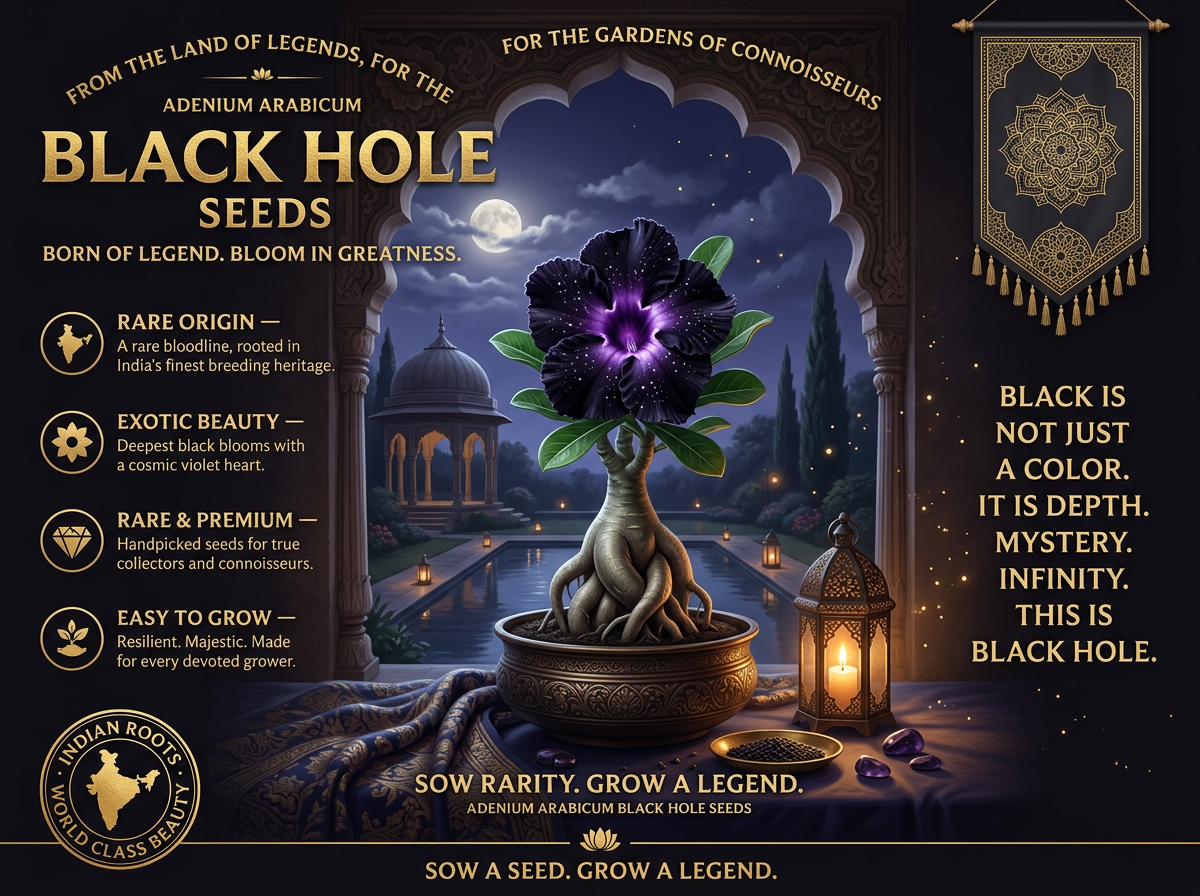
Adenium arabicum 'Black Hole' is a premium Thai arabicum cultivar developed within the same elite dark-skin breeding programs that produced Kalamae and Godji. The breeding objective is focused and unambiguous: maximum melanin expression in the epidermis, built onto a foundation of elite arabicum structural architecture. The result is a plant that, at peak development under optimal light conditions, reads less as a succulent and more as a piece of ancient, weathered obsidian with foliage growing out of it.
The Black Hole Lineage
Black Hole is a pure arabicum dark-skin selection — not a flower hybrid, not a cross chasing dark blooms. The focus is entirely on trunk pigmentation and bonsai structure. It belongs to the category of Thai cultivars that collectors pursue specifically for the moody, monolithic aesthetic of a near-black caudex in full development — the "Event Horizon" effect, as collectors sometimes describe the point at which the trunk achieves full dark saturation under peak UV exposure.
This distinction matters for buyers building a serious arabicum collection. Black Hole is not for growers who want dramatic flower color variation. It is for growers who understand that the most commanding adenium specimens are built around the trunk — and that the trunk is the point.
Key Visual Characteristics
Bark & Skin — The Event Horizon
The defining characteristic and the reason this cultivar exists. Standard arabicum bark presents as bright silver to pale gray-green. Black Hole is selected for maximum melanin expression — the trunk develops a deeply saturated dark purple-charcoal to matte-black epidermis under intense UV conditions. The texture amplifies the effect: as specimens age, the bark develops deep wrinkles, prominent branch scarring, and a rough, volcanic surface quality that is unlike any other arabicum in a collection. A mature Black Hole in full dark development is immediately recognizable as something different.
Caudex Geometry
Classic elite arabicum pancake form — low-profile, massively horizontal, squat dome-shaped caudex with very little vertical elongation. The plant expands outward, not upward. The low center of gravity and wide base create the visual stability and mass that defines premium arabicum bonsai aesthetics.
Nebari — The Root Architecture
Black Hole is specifically noted for producing heavy, highly structural lateral roots that radiate outward symmetrically from the caudex base. Trained with surface root exposure from early in development, the nebari becomes one of the most visually powerful elements of the mature specimen — a wide, aggressive root flare anchoring a dark, squat trunk. This is the root architecture that bonsai collectors are explicitly breeding toward, and Black Hole delivers it with the dark bark that amplifies the visual impact.
Branching & Canopy
Phenomenal self-branching. Black Hole throws a dense, uniform crown of short, stocky horizontal branches from the upper rim of the caudex. Internodes are tight. Branching is radial. The canopy builds naturally into a compact bonsai crown without constant heavy pruning intervention. Combined with the dark trunk below, the structural contrast between the dense green canopy and the near-black base is the visual signature of this cultivar.
Foliage
Broad, thick, and leathery — true arabicum leaf form. Under high-light conditions, leaf margins and veins develop deep purple stress-pigmentation that echoes the trunk coloration. The whole plant pulls toward a unified dark aesthetic when grown correctly.
Flowers
Classic star-shaped light pink to bright fuchsia — standard arabicum. This is intentional. The entire visual strategy of Black Hole is the contrast between soft, vibrant pink blooms and a pitch-black, massively muscular trunk. The flowers do not need to carry the drama. The bark handles that completely.
Cultivation Notes — Keeping the Black
Unfiltered UV Light is the Primary Requirement
The matte-black epidermis is a direct biological response to intense ultraviolet radiation — a protection mechanism triggered and maintained by UV exposure. This is not a variable trait that some plants express and others do not. All Black Hole specimens will develop their characteristic dark skin under the right conditions. All of them will fade toward dull smoky green under the wrong ones. Heavy greenhouse shade cloth, standard window glass, and low-output indoor lighting all suppress melanin production. Full, unfiltered direct sun outdoors — or high-output full-spectrum LED lighting indoors — is non-negotiable for maintaining the black epidermis that makes this cultivar worth growing.
In Zone 6, that means Black Hole gets the best outdoor sun position available from late May through early September, with no compromises. Every high-UV outdoor day builds dark skin. By late August and September, specimens that have had a full season of unfiltered sun will be at peak pigmentation.
Media
Root rot sensitivity is elevated in compact dark-skin arabicum cultivars relative to standard wild-type obesum. Black Hole requires hyper-porous, inorganic-dominant substrate — 80–90% pumice, black lava rock, and coarse perlite. I use Desert Oasis Potting Media for all my dark-skin Thai arabicum lines. The mineral-forward composition keeps oxygen exchange high around the compact root zone and eliminates residual moisture retention between waterings. Do not plant Black Hole in any mix that holds moisture.
Hard Winter Dormancy
Black Hole follows strict arabicum dormancy. When foliage yellows and drops in autumn, cease watering almost completely. A compact dark-skin arabicum caudex held in damp substrate at cool temperatures is extremely vulnerable to fast-moving caudex rot — there is very little buffer in the compact root zone once rot initiates. Dry storage, 55°F minimum, minimal to zero water until spring temperatures trigger active growth. The flush of pink blooms on bare, near-black branches in early spring is the reward for a correctly managed dormancy.
Zone 6 Notes
Outside after May 15 when nights hold reliably above 50°F — best direct sun position, no exceptions. I bring Black Hole in before first hard frost in mid-October, transition directly to dry dormancy storage, and do not resume watering until the plant shows clear signs of active growth in March or April. Properly managed, Black Hole improves every season — darker bark, wider nebari, denser canopy, more structural mass. It is a long-term growing investment that compounds value visually with each passing year.
WHAT'S INCLUDED
- Fresh Adenium arabicum 'Black Hole' seeds (select quantity above)
- Germination instructions included with every order
GROWING BASICS
- Germination temp: 85–95°F
- Germination time: 5–14 days under ideal conditions
- Hardiness: Bring indoors before nighttime temps reach 50°F
- Light: Full unfiltered direct sun mandatory — UV is the primary input for dark skin
- Media: 80–90% inorganic mineral mix required
- Dormancy: Hard winter dormancy — cease watering when leaves drop
- Skill level: Intermediate — light management and dormancy protocol are critical
What You'll Need to Grow These
Seeds are only half the equation — germination success comes down to the right setup. Here's what I use:
∙ Desert Oasis Potting Media — the fast-draining inorganic mix built for Adenium, Plumeria, and caudex seedlings once they're up and potted on.
∙ Luxbird Seed Germinator & Propagation Kit — bottom heat and a humidity dome, the two things that push arabicum germination toward the 90%+ range.
∙ 5×5 Germination Tray — sized for clean single-variety sowing so nothing gets crossed up.
See the full Desert Oasis media range at americanadenium.com.