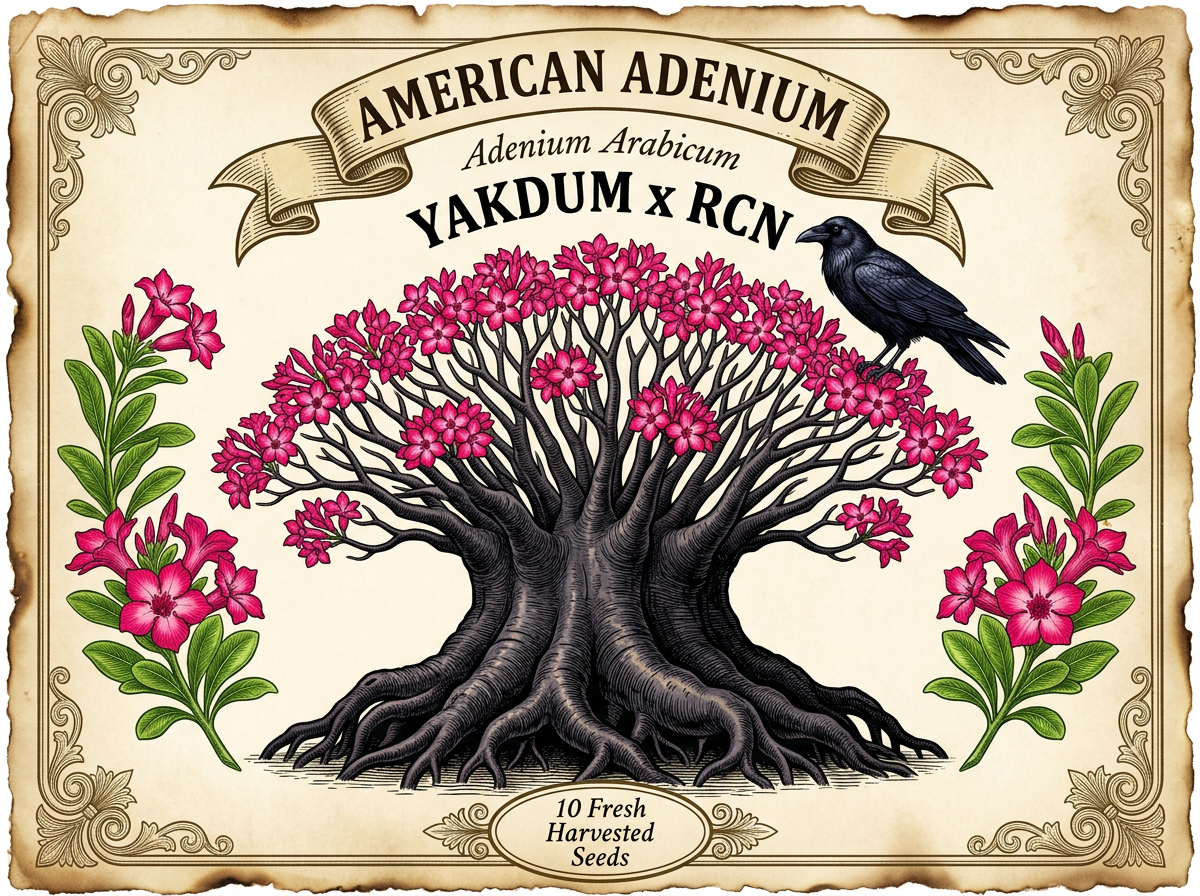
Adenium arabicum 'Yakdum' × 'RCN' — Black Queen Structural Hybrid Seeds
Adenium arabicum 'Yakdum' × 'RCN' — Black Queen Structural Hybrid Seeds
Couldn't load pickup availability
FREE U.S. SHIPPING ON ORDERS $75+ Mix and Match Seeds, Media and Supplies
Yakdum × RCN pairs two wildly opposing Thai arabicum powerhouses for one specific payoff: the flawless, radially organized branching and prolific flowering of RCN (Rachinee Pan Dok — "Queen of a Thousand Flowers") stamped onto the massive, jet-black, deeply muscular physique of Yakdum (Black Giant). The structural queen meets the dark colossus — the best selections from this cross earn the name "Black Queen" for good reason.
FULL PRODUCT DESCRIPTION
Adenium arabicum 'Yakdum' × 'RCN' is a legendary Thai arabicum pairing that deliberately combines two opposing genetic extremes — raw dark mass on one side, flawless branching symmetry and flower density on the other.
The Yakdum Contribution — Massive Scale, Dark Melanin & Muscular Caudex
Yakdum ("Black Giant") brings raw physical volume and intense dark skin genetics — huge, heavy, deep-set caudices maturing into dark bronze, smoky charcoal, or matte purple-black coloration. It is the color and mass anchor of this cross.
The RCN Contribution — Flawless Symmetrical Branching & Prolific Flowering
RCN (Rachinee Pan Dok — "Queen of a Thousand Flowers") is a foundational Thai arabicum matriarch. It brings textbook bonsai structure: an explosion of uniform, slender, perfectly spaced primary and secondary branches growing radially outward and upward. It is equally prized for exceptional flower count and bright green, velvety foliage.
The "Black Queen" Silhouette
The branching leans heavily toward the RCN side — abandoning the sometimes clumsy lateral growth of wild giants in favor of a dense, highly organized radial crown. The wood itself inherits the Yakdum melanin, maturing into a striking dark oily-bronze or charcoal patina. The lower trunk shows heavy, deep ridges and a sprawling, flared root system far heavier than a pure RCN would produce.
The Floral Show
When this cross enters full bloom, the massive density of RCN flower buds breaks across dark, bare Yakdum branches — a high-contrast showstopper that neither parent produces alone.
Root Training Potential
This cross is exceptional for advanced nebari work. RCN provides highly organized lateral root growth; Yakdum gives those roots massive thickness. Staged early over a plastic disc or tile, the result is an exceptionally wide, heavy root skirt that mirrors the organized crown above it.
As an F1 or advanced-generation cross, expect a natural sliding scale of trait expression. The most prized selections merge both parents fully — dark oily bark on a wide, ridged, muscular caudex with dense, organized RCN branching above. Others may lean toward Yakdum's sheer mass or RCN's refined structure — both directions produce compelling, collectible specimens.
Zone 6 Notes
Both traits depend on brutal UV intensity simultaneously — the Yakdum dark bark fades to smoky light green in low light while the RCN branch nodes stretch and lose their tight radial organization. Maximum unfiltered direct sun outside after May 15, no shade cloth, no filtering. The dense wood and heavy caudex mass store serious water volume — I run 85–90% inorganic (premium pumice, black lava rock, coarse perlite or hard Akadama) with no compromise on drainage. For root training, start the disc or tile technique early — the combination of RCN's organized lateral root growth and Yakdum's root thickness is as impressive below the soil line as the cross is above it. Hard winter dormancy: when foliage drops, water stops completely. Damp media during dormancy on a dark-skinned, heavy-caudex hybrid is a fast path to fatal rot. Indoors before first hard frost in mid-October, dry and cool until active spring growth resumes.
WHAT'S INCLUDED
- Fresh Adenium arabicum 'Yakdum' × 'RCN' seeds (select quantity above)
- Germination instructions included with every order
GROWING BASICS
- Germination temp: 85–95°F
- Germination time: 5–14 days under ideal conditions
- Hardiness: Bring indoors before nighttime temps reach 50°F
- Light: Maximum unfiltered direct sun or high-output full-spectrum LED — dark bark and tight RCN branching both degrade simultaneously in low light
- Media: 85–90% inorganic (premium pumice, black lava rock, coarse perlite or hard Akadama)
- Root training: Exceptional nebari candidate — RCN lateral organization plus Yakdum root thickness produces outstanding disc-trained root skirts
- Dormancy: Strict hard winter rest — zero water when foliage drops; damp dormancy media causes fatal rot
- Skill level: Intermediate to advanced — high genetic payoff but UV discipline, drainage, and dormancy protocol are all non-negotiable
What You'll Need to Grow These
Seeds are only half the equation — germination success comes down to the right setup. Here's what I use:
∙ Desert Oasis Potting Media — the fast-draining inorganic mix built for Adenium, Plumeria, and caudex seedlings once they're up and potted on.
∙ Luxbird Seed Germinator & Propagation Kit — bottom heat and a humidity dome, the two things that push arabicum germination toward the 90%+ range.
∙ 5×5 Germination Tray — sized for clean single-variety sowing so nothing gets crossed up.
See the full Desert Oasis media range at americanadenium.com.