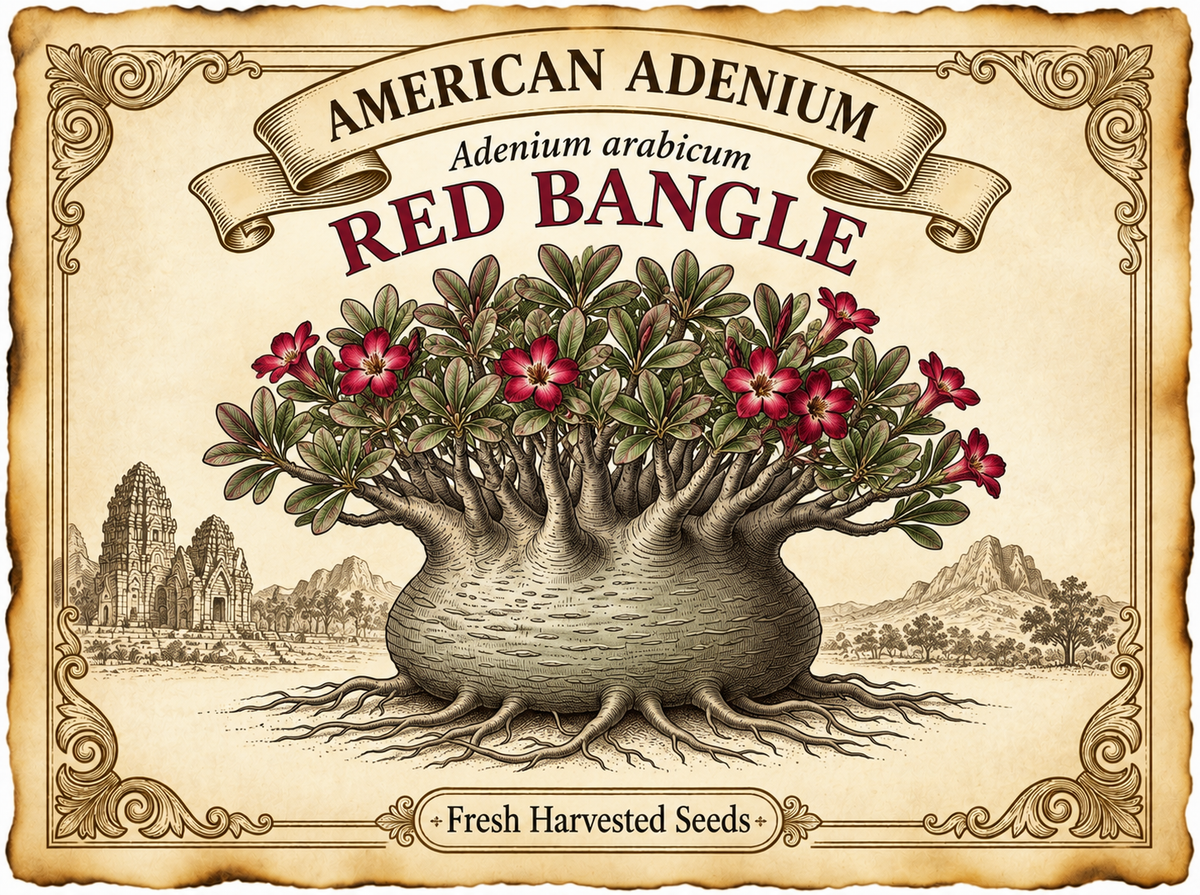
Adenium arabicum ‘Red Bangle’ — Dwarf Thai Turtle-Back Arabicum
Adenium arabicum ‘Red Bangle’ — Dwarf Thai Turtle-Back Arabicum
Couldn't load pickup availability
FREE U.S. SHIPPING ON ORDERS $75+ Mix and Match Seeds, Media and Supplies
A specialized dwarf Thai arabicum prized for its flattened turtle-back caudex, extreme natural multi-branching, silvery-green bark, and vivid red to magenta flowers. 'Red Bangle' remains exceptionally compact, making it an outstanding specimen for shallow-container staging and refined caudex display.
Full Product Description
Adenium arabicum 'Red Bangle' is a highly distinctive dwarf Thai arabicum cultivar known for its broad, flattened caudex and unusually dense natural branching.
Rather than developing a tall, upright form, Red Bangle concentrates its growth horizontally and radially. Mature plants may form a massive disc-like base resembling a turtle shell or pancake, with numerous short, thick stems emerging from the crown.
Caudex and Growth Habit
Red Bangle is recognized for its ultra-dwarf architecture and low center of gravity. The caudex expands outward into a broad, flattened form that is well suited to shallow containers and elevated specimen staging.
Plants produce dense centripetal branching, with many short, finger-like stems developing directly from the crown. This natural structure can create a highly branched silhouette without requiring hard cutbacks or aggressive crown pruning.
The result is a compact, sculptural plant with a wide footprint and strong visual presence despite its reduced height.
Bark and Branching Characteristics
The bark ranges from silvery green to light gray and may display prominent horizontal leaf scars along the trunk and branches. Micro-spaced internodes keep the terminal foliage tightly clustered and preserve the dwarf proportions of the plant.
With maturity, the dense branching structure can form a rounded, radial crown over the flattened caudex.
Foliage and Flowers
Leaves are small, oval, and slightly pubescent, remaining proportionate to the compact scale of the plant. Under favorable growing conditions, Red Bangle produces vivid reddish-pink to intense deep magenta blooms.
The saturated flowers contrast dramatically with the silver-green bark, giving the cultivar a refined and highly recognizable appearance.
Root Training Potential
The naturally broad basal structure makes Red Bangle an excellent candidate for early flat-board root training. With careful development, growers can encourage broad, sweeping radial roots that complement the flattened caudex and enhance the plant's presentation in a shallow container.
Root training should be gradual and timed to active growth, with careful attention to healing, drainage, and root health.
Seedling Variation
Seed-grown Red Bangle lines generally show strong stability for dwarf caudex expansion and natural multi-branching. However, individual plants may vary in branch density, caudex spread, bark tone, and flower intensity.
This variation is expected in seed-grown material and is part of the appeal for collectors developing unique Thai-style arabicum specimens.
Product Highlights
- Specialized dwarf Thai Adenium arabicum cultivar.
- Broad, flattened turtle-back or pancake-shaped caudex.
- Extreme natural multi-branching.
- Short, thick stems emerging from the crown.
- Compact horizontal and radial growth habit.
- Silvery-green to light gray bark.
- Micro-spaced internodes and dense foliage crowns.
- Small, slightly fuzzy oval leaves.
- Vivid reddish-pink to deep magenta flowers.
- Excellent candidate for shallow-container presentation.
- Strong potential for flat-board and radial root training.
Important Growing Note
Red Bangle is a seed-grown line, and individual plants may differ in caudex width, branch density, bark coloration, and flower expression. The cultivar is selected for its dwarf, spreading architecture and natural multi-branching, but mature form develops progressively with age, light, nutrition, and cultivation technique.
Images should be understood as representative of the cultivar type rather than a guarantee of the exact appearance of every seedling.