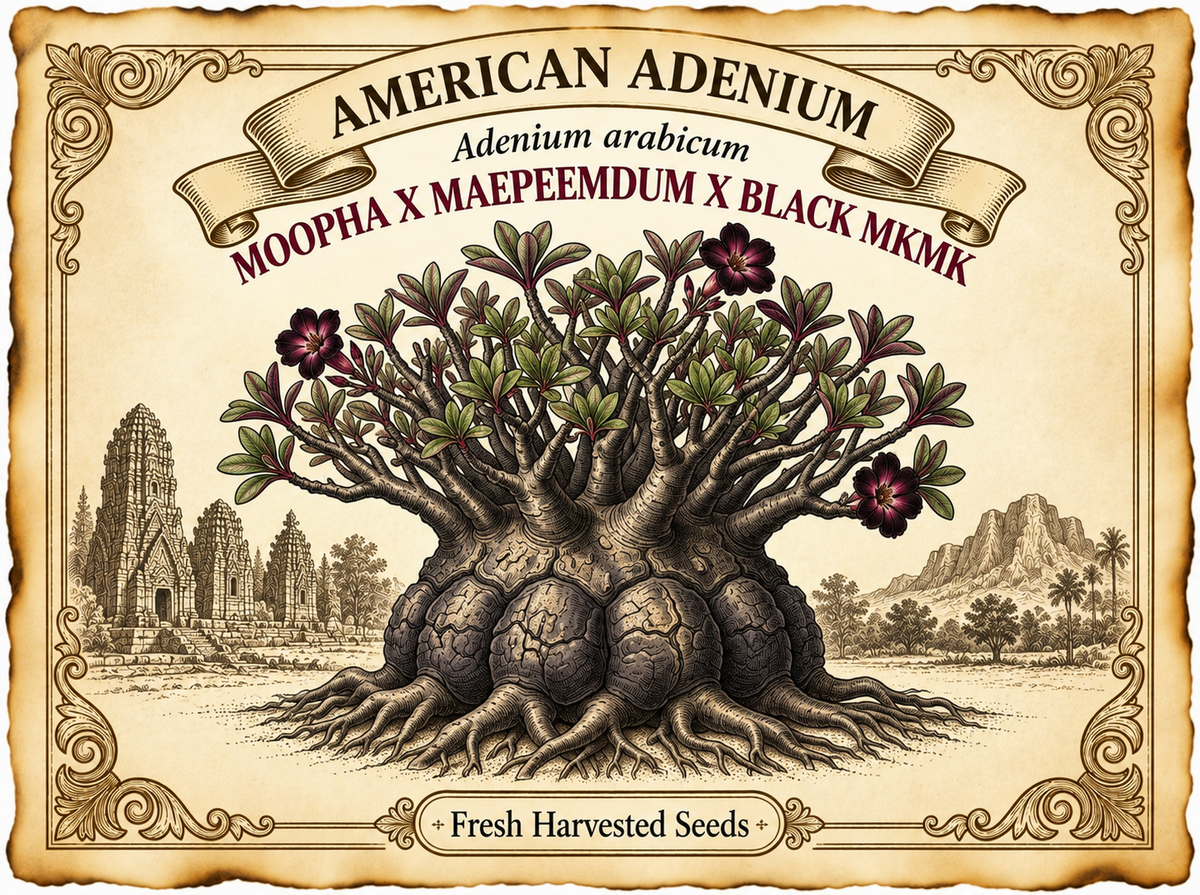
Adenium arabicum ‘Moopha × Maepeemdum × Black MKMK’ — Thai Black Dwarf Hybrid
Adenium arabicum ‘Moopha × Maepeemdum × Black MKMK’ — Thai Black Dwarf Hybrid
Couldn't load pickup availability
FREE U.S. SHIPPING ON ORDERS $75+ Mix and Match Seeds, Media and Supplies
A high-tier Thai complex hybrid combining an ultra-dwarf, broad-based caudex with intense dark pigmentation, dense crown branching, and strong radial root development. This cross brings together the compact structure of Moopha, the dark-skin genetics of Maepeemdum, and the symmetrical root architecture of Black MKMK.
Full Product Description
Adenium arabicum 'Moopha × Maepeemdum × Black MKMK' is a complex Thai hybrid created by layering three highly distinctive arabicum lines. The cross was developed to unite extreme dwarf caudex structure, dark anthocyanin-rich bark, dense centripetal branching, and strong radial root potential.
The most desirable seedlings may express the coveted black dwarf phenotype: a broad, low-growing Moopha-style caudex combined with the charcoal-to-black pigmentation associated with Maepeemdum and Black MKMK.
Genetic Profile
Moopha, or "Wild Boar," contributes:
- Ultra-compact dwarf growth.
- Broad turtle-shell or conical caudex structure.
- Thick, stubborn main stems.
- Strong resistance to excessive vertical growth.
Maepeemdum, associated with "Black Queen" or "Black Mother," contributes:
- High anthocyanin expression.
- Charcoal, purplish, and near-black skin tones.
- Darker leaf undersides.
- Compact node spacing.
Black MKMK, or Muang Mai Klong Kian, contributes:
- Balanced radial root flare.
- Thick octopus-style branch architecture.
- Symmetrical crown development.
- Deep bronze-black bark coloration.
Bark and Pigmentation
Seedlings may develop deep bronze, purplish-charcoal, or jet-black skin. Pigmentation is expected to become more pronounced under intense direct sunlight and high ultraviolet exposure, especially across the upper caudex and primary branches.
Under strong light, the bark may develop a dark metallic appearance, with color intensity varying according to genetics, age, growing conditions, and seasonal light levels.
Caudex and Branching Architecture
The Moopha influence keeps growth low and broad, encouraging a heavy, swollen basal caudex rather than a tall, narrow trunk. Plants may remain extremely squat, although some seedlings will express a somewhat taller and more symmetrical Black MKMK-style structure.
Crown branching is expected to be prolific. Short, thick branches may emerge directly from the crown with minimal need for hard decapitation or aggressive pruning. Internodes tend to remain short, creating a dense and compact canopy.
The Black MKMK influence also gives this cross excellent potential for broad, balanced radial root development. With careful early training, seedlings may be developed into centipede-style or flat-board specimens.
Foliage and Growth
Leaves are small, thick, and semi-glossy to finely pubescent. In intense sunlight, leaf margins and petioles may show reddish-purple coloration.
Although the Moopha parent contributes strong dwarf characteristics, the complex-cross vigor may help seedlings establish robust roots and thick stems more rapidly than some pure dwarf lines.
Seedling Variation
This is a complex, multi-generational seed-grown cross rather than a uniform clone. Individual seedlings may vary considerably in:
- Degree of dwarfism.
- Caudex width and shape.
- Bark pigmentation.
- Branch density.
- Radial root development.
- Overall crown height and symmetry.
Some plants may remain exceptionally flat and dense, closely reflecting Moopha. Others may develop a slightly taller, more evenly radial form associated with Black MKMK. The most sought-after plants will combine an ultra-squat caudex with the darkest possible bark.
Product Highlights
- Complex Thai Adenium arabicum hybrid.
- Cross involving Moopha, Maepeemdum, and Black MKMK.
- Potential for deep bronze, charcoal, purplish, or near-black bark.
- Ultra-dwarf, broad-based caudex potential.
- Dense natural crown branching.
- Short, thick, closely spaced branches.
- Strong radial and octopus-style root development.
- Excellent candidate for flat-board and centipede root training.
- Small, thick, semi-glossy to slightly fuzzy foliage.
- Potential reddish-purple leaf margins and petioles.
- High-value genetic combination for collectors.
- Significant seedling variation and individual expression.
Important Growing Note
This is a seed-grown complex hybrid, so no two seedlings should be expected to develop identically. Dark skin, extreme dwarfism, branch density, caudex width, and radial root structure will vary among individual plants.
The most intense bark coloration develops only under suitable conditions and should not be expected immediately in young seedlings. Provide strong light, warm temperatures, excellent drainage, and controlled watering during active growth. Root training should be gradual and performed only on healthy, actively growing plants.