Adenium arabicum 'Krishna' — Golden Standard Root-Flare Thai Hybrid Seeds
Adenium arabicum 'Krishna' — Golden Standard Root-Flare Thai Hybrid Seeds
Couldn't load pickup availability
FREE U.S. SHIPPING ON ORDERS $75+ Mix and Match Seeds, Media and Supplies
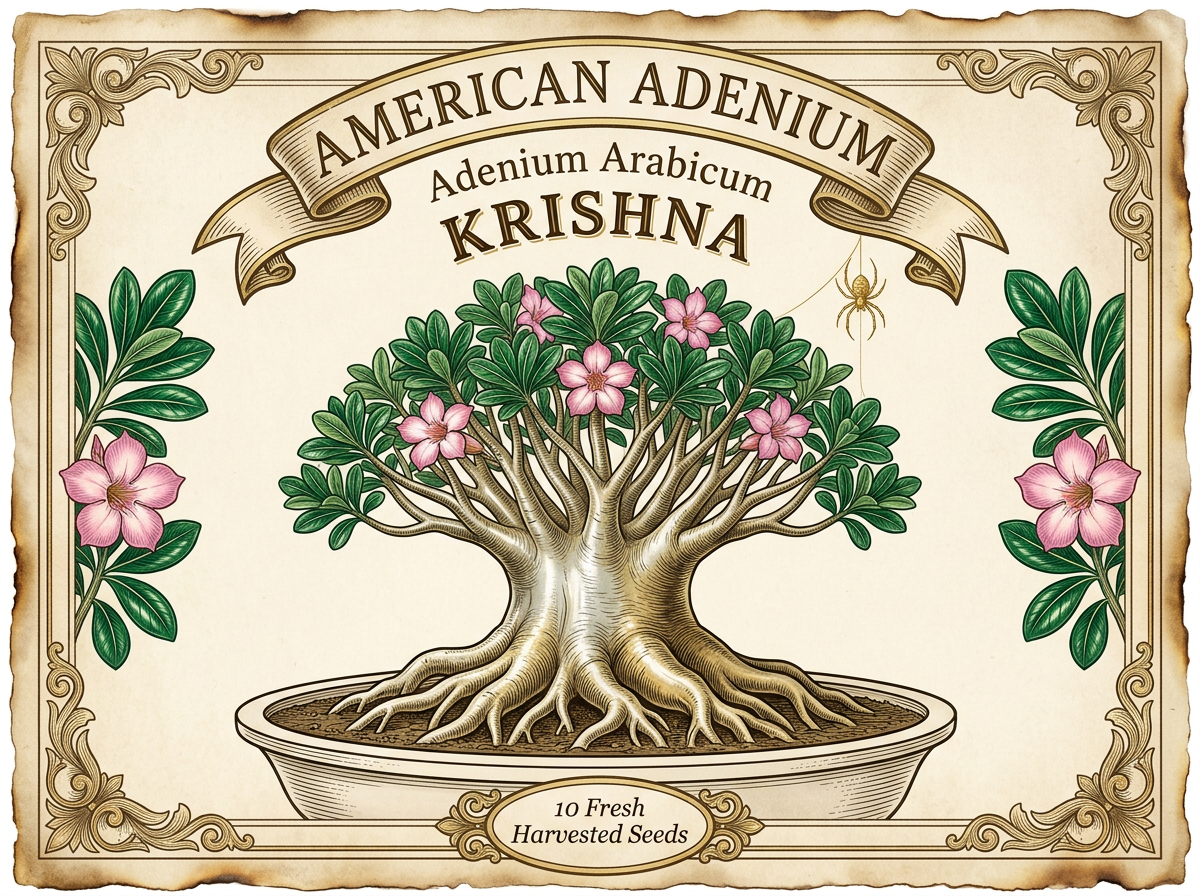
Krishna (also seen as Krisana or Chao Phraya Krishna) is one of the definitive structural icons of the Thai Adenium hobby — revered alongside Khao Hin Zan and Bangkla as a foundational lineage. Its hallmark is a perfectly geometric, dome-shaped crown of rigid 45-degree branches above a heavily flared, wide-spreading nebari that makes it the premier choice for advanced root-training techniques.
FULL PRODUCT DESCRIPTION
Adenium arabicum 'Krishna' is a legendary Thai Socotranum/Arabicum hybrid lineage that has anchored elite breeding programs and competition benches for decades. When collectors talk about a pure Krishna type, they are looking for a single, precise combination: perfect structural geometry on top, sweeping radial root mechanics on the bottom.
The Symmetrical Golden-Ratio Canopy
Krishna's defining structural trait is the organization of its upper wood. It naturally throws an abundance of perfectly uniform, highly rigid primary branches growing upward and slightly outward at a balanced 45-degree angle — a beautifully spaced dome-shaped crown that rarely requires wiring or pruning to maintain structural clarity.
The "Flared Skirt" Caudex and Nebari
Krishna is equally famous for its lower-body mechanics. The caudex grows into a wide, heavily swollen cone or low-slung dome, setting an aggressive footprint by shooting thick, heavy lateral roots that radiate evenly into the soil. This classic nebari makes it the automatic first choice for shallow bonsai-pot staging and advanced root-flaring techniques.
The Bark Patina
Epidermis develops a smooth, pale silver-gray to slightly golden-tan sheen — light skin that accentuates the shadows between muscular trunk divisions, giving even young specimens a highly weathered, ancient-tree appearance.
Foliage
Distinctly Thai Socotranum-leaning: compact, oval-shaped, highly glossy, deep emerald green with crisp, prominent pale green midribs. Lacks the heavy velvet pubescence of more rustic wild-type arabicums — clean, smooth, and reflective.
The Premier Root-Training Line
Krishna carries some of the strongest naturally radiating root genetics in the hobby. It is the variety collectors reach for first when practicing advanced root-flaring over a plastic disc or ceramic tile to force a perfect 360-degree flat nebari. The genetics want to do the work — the grower's job is to direct it.
Zone 6 Notes
Krishna's tight, stacked internode geometry holds only under brutal maximum-intensity light — bench it under greenhouse shade cloth or weak indoor conditions and those beautifully organized branches stretch out, permanently breaking the geometric canopy. Outside in full unfiltered direct sun after May 15, no exceptions. The heavy, dense wood mass and large water-storing caudex are completely intolerant of stagnant moisture — I run 85–90% inorganic (premium pumice, black lava rock, coarse perlite or hard-fired clay) with no compromise. Deep winter dormancy: when the glossy foliage drops in autumn, water stops entirely. Premium dwarf hybrid roots in cool damp media rot fast and without warning. Indoors before first hard frost in mid-October, dry and cool until active spring growth resumes. If you are going to practice disc root-training, start early — Krishna responds to that technique better than almost anything else in the collection.
WHAT'S INCLUDED
- Fresh Adenium arabicum 'Krishna' seeds (select quantity above)
- Germination instructions included with every order
GROWING BASICS
- Germination temp: 85–95°F
- Germination time: 5–14 days under ideal conditions
- Hardiness: Bring indoors before nighttime temps reach 50°F
- Light: Maximum unfiltered direct sun or high-output full-spectrum LED — tight internode geometry depends on brutal UV intensity
- Media: 85–90% inorganic (premium pumice, black lava rock, coarse perlite or hard-fired clay)
- Root training: Premier disc/tile root-flaring candidate — strong natural nebari genetics respond exceptionally well to advanced training
- Dormancy: Strict hard winter rest — zero water when glossy foliage drops; cool damp media causes rapid caudex rot
- Skill level: Intermediate to advanced — excellent natural branching, but light discipline and root-training technique unlock full genetic potential
What You'll Need to Grow These
Seeds are only half the equation — germination success comes down to the right setup. Here's what I use:
∙ Desert Oasis Potting Media — the fast-draining inorganic mix built for Adenium, Plumeria, and caudex seedlings once they're up and potted on.
∙ Luxbird Seed Germinator & Propagation Kit — bottom heat and a humidity dome, the two things that push arabicum germination toward the 90%+ range.
∙ 5×5 Germination Tray — sized for clean single-variety sowing so nothing gets crossed up.
See the full Desert Oasis media range at americanadenium.com.