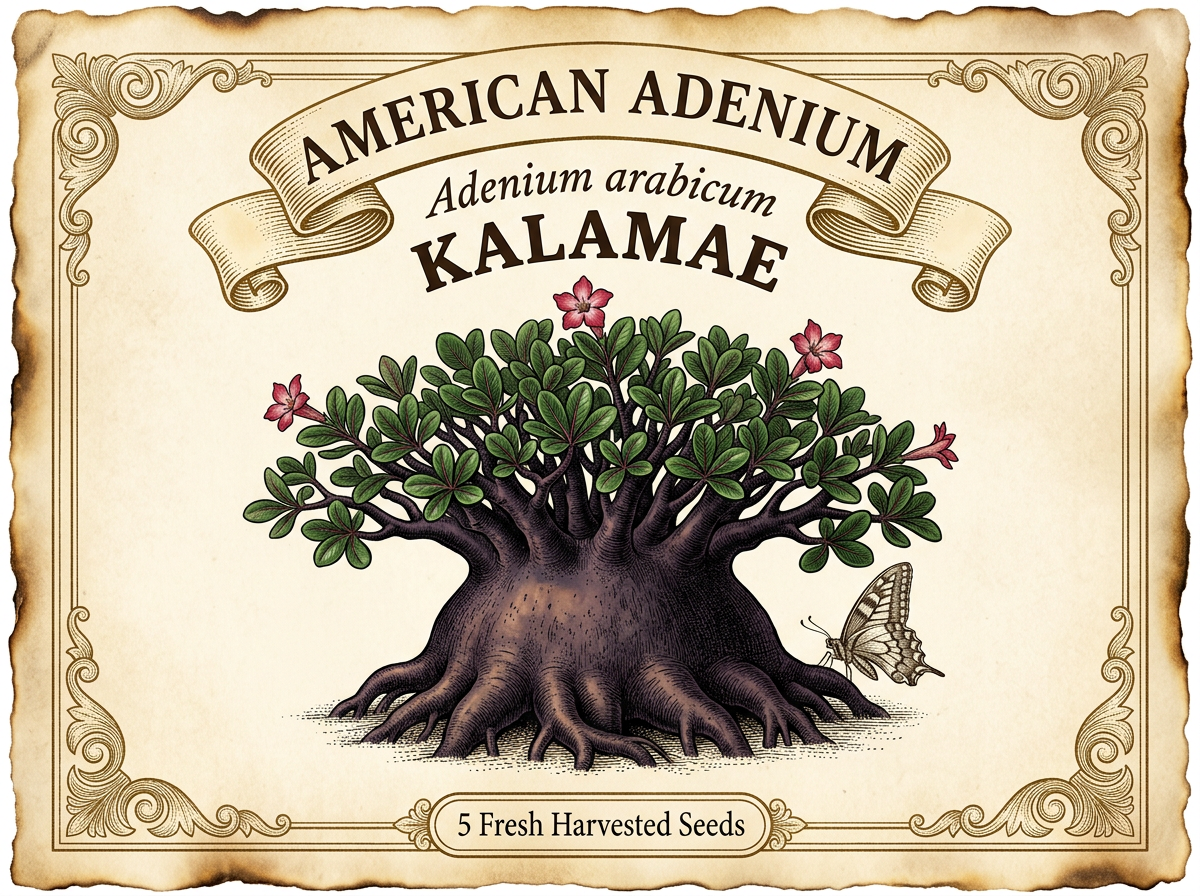
Adenium arabicum 'Kalamae' (F2) Seeds — Dark-Barked Thai Cultivar - 10 Seed Pack
Adenium arabicum 'Kalamae' (F2) Seeds — Dark-Barked Thai Cultivar - 10 Seed Pack
Couldn't load pickup availability
FREE U.S. SHIPPING ON ORDERS $75+ Mix and Match Seeds, Media and Supplies
Kalamae is one of the darkest-barked Adenium arabicum cultivars in circulation. It is named after the Thai sweet — a sticky, near-black confection of coconut milk and palm sugar — and the name is accurate. Under strong sun the branches and upper caudex run purplish-black to deep maroon-bronze, not the green or silver skin you get on standard arabicum.
I source this line from Thailand and grow it out here in Northern Kentucky. What follows is what the seed actually does, including where it does not perform.
What you get from this line
- Dark pigmentation. The color is real, but it is sun-driven. Grown under shade cloth or a north window, Kalamae looks like an ordinary arabicum. Grown under full unfiltered sun, the stems darken hard. If you want the black wood, you have to earn it with light.
- Compact, domed canopy. Short internodes and dense radial branching close to the caudex crown. This line branches on its own — you do not need aggressive hard-pruning to force a multi-branch head, though a single tip cut in the first year still tightens it further.
- Broad caudex with radial structural roots. The base fattens wide rather than tall, and the roots come off the crown in a flat radiating pattern. That makes it one of the better arabicum lines for flat-board root training or staging in a shallow bonsai pot.
- Small, thick, glossy leaves, often slightly cupped. Under high light the petioles and leaf undersides show reddish-purple veining.
- Flowers are single, pinkish-red, and secondary. Nobody grows Kalamae for the bloom. You grow it for the wood and the base.
What F2 actually means here
This is worth understanding before you buy, because the label gets thrown around loosely.
Adenium arabicum grown from seed does not come out as identical clones the way a grafted plant does. Every seedling is its own genetic event. F2 means this seed came from selected F1 parents that traced back to the original imported Thai Kalamae mother stock — so the desirable traits have been through one round of selection and stabilization.
In practice, an F2 batch throws a much higher percentage of authentic Kalamae expression — dark bark, tight node spacing, fat base — than open-pollinated arabicum seed sold as "Kalamae." It does not throw 100%. Expect real variation within a batch in trunk skin tone, growth rate, and branching density. Some will be standouts. Some will be ordinary. That is what seed-grown caudiciforms are, and anyone telling you otherwise is selling you something.
My honest advice: sow more than you think you need and select at 18–24 months, when the bark color and branching habit have declared themselves. Cull or trade the plain ones.
Growing it in a cold climate
Germination is the easy part — fresh arabicum seed is fast and forgiving in warm, bright conditions. The part that trips up Zone 6 growers is the first winter.
Kalamae's compact habit means a lot of stored water in a short, wide caudex, and that base is what rots when a cold-climate grower keeps watering into a dark November. In my operation, first-year seedlings go dry and stay dry once night temps under lights drop below about 55°F, and they do not get water again until they push new growth in spring. Seedlings under a year old are the least forgiving of that transition — they have less reserve than a mature plant but the same rot vulnerability.
Media matters more here than it does in Florida or Thailand. Our winter light is weak and our indoor humidity swings hard, so a mix that dries slowly will hold water against the caudex for weeks. I germinate and grow this line in Desert Oasis Germination Media and step it into Desert Oasis Potting Media at first transplant. That is the same protocol I use on everything in the arabicum house.
Quick reference
- Light: Full, unfiltered sun. Non-negotiable if you want the dark bark.
- Germination temp: 80–85°F, bright, surface-sown or barely covered
- Water: Heavy in active growth, fully dry in dormancy
- Cold limit: Keep above 50°F. This is not a plant that takes frost.
- Habit at maturity: Wide, low, densely branched, fat-based
What's included
- 10 fresh Adenium arabicum 'Kalamae' F2 seeds
- Germination instructions written for cold-climate conditions
Seed is sold fresh and germination rates fall off with age. Sow promptly. Ships within the US only.