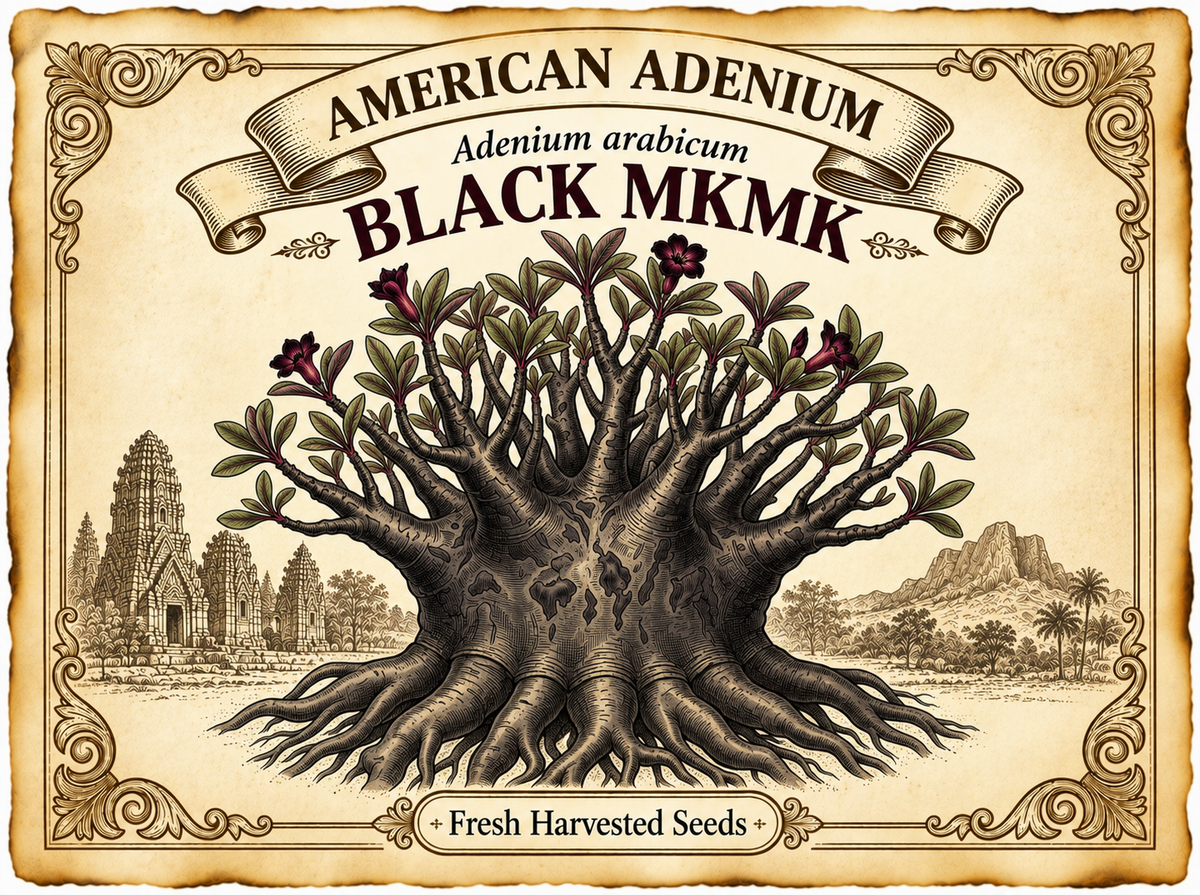
Adenium arabicum ‘Black MKMK’ — Dark Thai Muang Mai Klong Kian
Adenium arabicum ‘Black MKMK’ — Dark Thai Muang Mai Klong Kian
Couldn't load pickup availability
FREE U.S. SHIPPING ON ORDERS $75+ Mix and Match Seeds, Media and Supplies
A distinguished Thai arabicum lineage prized for dark purplish-charcoal bark, broad radial root flare, and a balanced, symmetrical branching structure. 'Black MKMK' combines the structural strength of Muang Mai Klong Kian with intensified dark-skin genetics, making it an excellent choice for serious caudiciform collectors and long-term root training.
Full Product Description
Adenium arabicum 'Black MKMK' is a rare Thai hybrid lineage associated with Muang Mai Klong Kian, commonly abbreviated as MKMK. The line is valued for its combination of massive basal development, strong radial architecture, dense branching, and dark bark pigmentation.
Selected Black MKMK plants may express deep bronze-chocolate, charcoal-purple, or purplish-black skin, particularly when cultivated under intense direct sunlight.
Lineage and Structure
Muang Mai Klong Kian is recognized for its broad caudex flare and dense branching habit. Black MKMK selections combine these structural traits with high-anthocyanin dark-skin genetics.
Unlike ultra-dwarf arabicums that remain almost flush with the soil, Black MKMK generally develops a sturdy, medium-compact canopy. Thick branches emerge from the central crown and radiate upward and outward in a balanced arrangement.
Bark and Pigmentation
The bark may range from deep bronze and chocolate tones to dark charcoal-purple. Color intensity often increases with strong sunlight and high ultraviolet exposure.
Under suitable growing conditions, the branches and upper caudex can become noticeably darker than standard green or silver arabicum forms. Pigmentation will vary according to genetics, light intensity, age, and cultivation conditions.
Caudex and Root Development
Black MKMK naturally develops a broad, swollen basal caudex with an octopus-like radial root system. This structure makes the line especially well suited to long-term centipede-style and flat-board root training.
Seed-grown plants are particularly valuable for collectors interested in developing the plant's natural basal architecture. With patient cultivation, the root flare can become a dominant feature of the mature specimen.
Foliage and Flowers
Leaves are small to medium in size and may be semi-glossy or slightly pubescent. In full sun, the leaf veins and petioles can develop reddish-purple coloration that complements the darker bark.
Flowers are typically soft pink to pinkish red. While the blooms provide seasonal color, the principal ornamental value of Black MKMK lies in its dark wood, swollen caudex, radial root structure, and balanced branching.
Seed-Grown and Grafted Plants
Seed-grown Black MKMK plants develop their own individual caudex form and radial root pattern. They may show good stability for dark skin and strong basal flare, although the precise intensity of bark coloration will vary between seedlings.
Grafted specimens preserve the established clone's characteristic dark bark coloration while growing on a developed rootstock. Seed-grown and grafted plants should therefore be considered different collector experiences, each with distinct advantages.
Product Highlights
- Rare Thai Adenium arabicum lineage.
- Associated with Muang Mai Klong Kian.
- Deep bronze-chocolate to charcoal-purple bark.
- Dark pigmentation may intensify under strong direct sunlight.
- Broad, symmetrical caudex development.
- Strong radial and octopus-like root flare.
- Balanced upright-to-spreading branch structure.
- Medium-compact growth habit.
- Small to medium semi-glossy or slightly fuzzy leaves.
- Potential reddish-purple veins and petioles.
- Soft pinkish-red flowers.
- Excellent candidate for flat-board and centipede root training.
- Available as a seed-grown or grafted collector specimen, where applicable.
Important Growing Note
Color expression and plant architecture depend on genetics, light intensity, temperature, nutrition, water management, and age. Seed-grown plants will show individual variation in bark darkness, branch arrangement, caudex development, and root flare.
For the strongest pigmentation and compact structure, provide intense light, excellent drainage, warm temperatures, and a controlled watering cycle during active growth. Avoid treating bark darkening as a fixed trait; coloration can change with growing conditions and seasonal light levels.